Blog

Level Up with HackerEarth

Where innovation meets insight.
Explore expert perspectives, emerging tech trends, and real-world stories in coding, hiring, AI, and hackathons. Whether you're building, hiring, or learning — this is your go-to hub for sharp insights and practical knowledge from across the global developer ecosystem.
Featured and trending

Stay Ahead with the HackerEarth Blog

Dive into the latest in tech innovation, industry updates, and thought leadership. Discover what’s shaping the future — one post at a time.
Arrow Left
Arrow right

AI Interview: What is an AI Interviewer? Guide for 2026

Discover what an AI interview Agent is, how it works, and the 7 best platforms for technical hiring. Reduce bias by 30%, hire faster, and improve candidate experience in 2026
Author
Vikas Aditya
Calendar Icon
February 23, 2026
Timer Icon
3 min read

AI Interview: What is an AI Interview Agent? The Complete Guide for Technical Hiring (2026)

As technology transforms recruitment, AI interviews are revolutionizing how companies identify and assess top technical talent. In a recent study by Chicago Booth’s Center for Applied Artificial Intelligence, over 70,000 job applicants were screened using AI-led interviews—and the results were striking: AI interviews led to 12% more job offers, 18% more job starters, and 16% higher retention rates after 30 days of employment. In 2026, AI interviewers have become a standard component in high-volume hiring processes, supporting smarter hiring for organizations around the world. AI interviewers now streamline the entire hiring process, from screening to decision-making, enabling more intelligent and efficient recruitment practices. By screening thousands of candidates simultaneously, AI can reduce recruitment costs by up to 30%. Discover how AI-powered interviewing is reshaping the hiring landscape and delivering unprecedented efficiency for technical teams worldwide.

What is an AI Interview Agent?

An AI interview Agent is an automated system powered by artificial intelligence that conducts technical interviews without human intervention. Unlike traditional interviewing methods that rely entirely on human recruiters, AI interviewers leverage machine learning models, natural language processing, and sophisticated evaluation algorithms to assess candidate skills in real time. By understanding the context of candidate responses—including the background and details of the conversation—AI interviewers enhance decision-making and improve overall interview quality.

The difference between AI interview Agent and traditional methods is fundamental. Human interviewers, despite their best intentions, often lose 15+ hours each week conducting candidate assessments. Their evaluations can vary wildly as standards shift across individuals, and unconscious bias frequently creeps in based on personal preferences or even mood. AI interviewers eliminate these inconsistencies by applying standardized rubrics to every evaluation. Additionally, AI interviewers can emulate the functions of a recruiting team, supporting or replicating candidate screening and assessment processes to increase efficiency and objectivity.

The key technological components powering AI interviews include:

  • Natural Language Processing (NLP): Enables the AI to understand and respond to candidate answers in real time, creating natural, conversational flows and allowing the system to create customized, inclusive, and multilingual interview experiences
  • Adaptive Questioning Algorithms: Each response shapes the next question, ensuring candidates are neither over-challenged nor under-tested
  • Real-Time Code Evaluation: For technical roles, AI systems can assess code quality, efficiency, and problem-solving approaches instantly
  • Video Avatar Technology: Advanced platforms like HackerEarth’s AI Interview Agent use lifelike video avatars to deliver human-like interview experiences that put candidates at ease

Benefits of AI-Powered Technical Interviews

The advantages of implementing AI interviews for technical hiring extend far beyond simple automation. Organizations are discovering that these systems fundamentally transform their ability to identify and secure top talent. AI interviewers can efficiently screen candidates, automating and expediting the evaluation process to handle large applicant pools with speed and consistency.

Time and Resource Savings

Senior engineers typically spend 1-2 hours per interview, often losing 15+ hours weekly on candidate assessments. This drains productivity from critical projects and creates bottlenecks in the hiring pipeline. AI interviewers handle high-volume repetitive screenings, freeing your most valuable technical minds to focus on innovation rather than interviewing logistics.

Consistent and Bias-Free Candidate Evaluation

According to research from Chicago Booth, when given the option to interview with an AI agent or human recruiter, 78% of applicants opted for the AI interviewer. Why? Many candidates found AI-driven interviews less intimidating and more efficient. The AI masks personal information that can introduce bias, maintains perfect recall of every answer, and applies consistent evaluation standards regardless of when the interview takes place.

24/7 Availability and Scalability

Unlike human recruiters constrained by working hours and time zones, AI interviewers are always available. This 24/7 accessibility means candidates can interview at their convenience, reducing scheduling friction and accelerating time-to-hire. Manual notes and redundant interviews often lead to delays in the hiring process, resulting in vague feedback and increased candidate drop-off. AI interviewers help reduce these issues by streamlining communication and feedback, ensuring a smoother experience and minimizing candidate drop-offs. For global companies hiring across multiple regions, this scalability is transformative.

Data-Driven Candidate Insights

AI interview platforms generate comprehensive evaluation matrices covering every technical dimension. HackerEarth's system, for example, provides detailed scoring rationales for each assessment point, drawing on insights from over 100 million assessments and a library of 25,000+ curated technical questions. This data-driven approach gives hiring teams clarity, consistency, and confidence in every decision.

Types of Interviews: Real Interviews vs. AI Interviews

In the modern hiring process, interviews are the gateway to discovering top talent and ensuring the right fit for your team. Traditionally, real interviews—conducted face-to-face or via video by human interviewers—have been the standard for screening candidates. While these interviews offer a personal touch, they can be time-consuming, subject to unconscious bias, and difficult to scale as your talent needs grow.

AI interviews, on the other hand, leverage advanced ai agents to conduct structured, unbiased conversations with candidates. This approach allows organizations to screen more candidates in less time, ensuring that every candidate receives a fair shot at demonstrating their skills and problem-solving abilities. By automating the initial stages of the interview process, AI interviews help recruiting teams focus their attention on the best candidates, reducing screening time and minimizing the risk of bias creeping into evaluations.

Unlike real interviews, which can vary in consistency and are limited by interviewer availability, AI interviews operate at scale—delivering a standardized, data-driven assessment for every candidate. This not only streamlines the process for hiring teams but also ensures that qualified candidates are identified efficiently and fairly, supporting a more inclusive and effective approach to technical hiring.

How AI Interviews Work: Technical Assessment Mechanics

Understanding the mechanics behind AI interviews reveals why they’ve become so effective for technical hiring. The process combines multiple sophisticated technologies working in concert. By leveraging data and analytics, AI interviews support a broader talent strategy—optimizing hiring processes, improving interview quality, and increasing overall recruitment effectiveness.

AI Screening and Matching Processes

The journey begins with intelligent candidate screening. AI systems analyze applications, match candidate profiles against role requirements, and prioritize the most promising applicants for interviews. This initial filtering ensures human recruiters focus their limited time on candidates most likely to succeed.

Technical Skill Evaluation Techniques

During the interview, AI evaluators assess candidates across multiple dimensions:

  • Problem-Solving Approach: How candidates break down complex problems and develop solutions
  • Technical Communication: The ability to explain technical concepts clearly
  • Architecture Understanding: For senior roles, deep-dives into system design and architecture decisions
  • Code Quality: Real-time assessment of code efficiency, stability, and scalability

The AI-driven interview experience feels as natural and seamless as a traditional in-person interview, with candidates often describing the process as authentic in every sense of the word.

Integration of Coding Challenges and Assessments

Modern AI interview platforms seamlessly integrate coding challenges within the interview experience. The AI can observe candidates coding in real time across 30+ programming languages, evaluate their approach to debugging, and assess their familiarity with frameworks like React, Django, Spring Boot, and cloud platforms including AWS, Azure, and GCP.

Machine Learning Model Development

The intelligence behind AI interviewers continuously improves. Platforms like HackerEarth leverage hundreds of millions of evaluation signals to refine their AI models. This means the system becomes more accurate and effective over time, learning from each interview to better predict candidate success.

Candidate Experience in AI Interviews

A positive candidate experience is essential for attracting and retaining top talent, and AI interviews are designed with this in mind. The ai interview process is built to be intuitive and conversational, helping candidates feel comfortable and confident as they showcase their skills. AI powered insights provide candidates with immediate feedback on their performance, offering valuable guidance for improvement and boosting their confidence throughout the interview process.

By leveraging AI, interviews become more than just assessments—they transform into interactive experiences where candidates can engage naturally, receive actionable feedback, and gain a clearer understanding of their strengths. This modern approach not only enhances the candidate experience but also ensures that the interview process is fair, transparent, and focused on uncovering true potential.

Candidate Satisfaction and Engagement

Candidate satisfaction and engagement are at the heart of successful AI interview platforms. Research consistently shows that candidates appreciate the fairness, transparency, and efficiency of AI interviews. Many report feeling that the process gives them a genuine opportunity to demonstrate their abilities, free from the biases that can sometimes influence traditional interviews.

AI interviews also help hiring teams tap into a broader and more diverse talent pool, identifying untapped talent that might otherwise be overlooked. By creating a more engaging and interactive interview experience, recruiting teams can foster higher levels of candidate satisfaction, leading to stronger employer branding and a more robust pipeline of qualified candidates. Ultimately, this approach not only benefits candidates but also empowers organizations to build teams that reflect a wider range of skills and perspectives.

Addressing Concerns: AI Interview Limitations and Ethics

Despite their advantages, AI interviews raise legitimate concerns that organizations must address thoughtfully.

Potential Bias Mitigation Strategies

While AI can eliminate many forms of human bias, it's essential to ensure the underlying algorithms don't perpetuate historical biases from training data. Leading platforms implement strict bias auditing, use diverse training datasets, and mask critical personal information that could introduce bias. As SHRMLabs' Managing Director Guillermo Corea notes, "Standardized interviewing processes and AI can mitigate biases and ensure the best candidates fill roles."

Maintaining Human Touch in AI Interviews

The concern that AI interviews feel cold or impersonal is valid—but technology is rapidly addressing this. Video avatar technology creates more engaging, human-like experiences. HackerEarth's AI Interview Agent, for instance, uses a lifelike video avatar that creates a sense of presence, making conversations feel natural and putting candidates at ease.

Privacy and Data Security Considerations

Enterprise-grade AI interview platforms prioritize data security. Look for solutions offering 99.99% server uptime, robust data encryption, and compliance with privacy regulations. Transparency about how candidate data is collected, stored, and used is essential for building trust.

Complementing AI with Human Expertise

The most effective approach combines AI efficiency with human judgment. As Dr. Brian Jabarian of Chicago Booth explains, "It's not yet possible to delegate the more nuanced, in-depth evaluation of candidates entirely to AI. We will need human intervention to oversee and review the performance of AI recruiters." The Chicago Booth research found that while AI-led interviews improved hiring metrics, final hiring decisions were still made by human recruiters—demonstrating the power of human-AI collaboration.

Implementing AI Interviews in Your Technical Hiring Strategy

Ready to transform your technical hiring with AI interviews? Here’s how to approach implementation strategically. Many AI interviewer platforms allow you to get started with no credit card required, making it easy to try the service risk-free.

Selecting the Right AI Interviewing Platform

When evaluating platforms, prioritize these criteria:

  • Technical Depth: Does the platform have a robust question library? HackerEarth offers over 25,000 curated questions compared to the 50-100 generic questions in many competing solutions
  • Engagement Quality: Does it use video avatars for natural conversation, or just audio with delays?
  • Adaptive Capabilities: Can the AI conduct advanced follow-up questioning based on candidate responses?
  • Enterprise Features: Consider SSO integration, role-based permissions, and ATS integration capabilities
  • Proven Results: Look for platforms trusted by leading companies—HackerEarth is used by 4,000+ companies including Google, Amazon, Microsoft, and PayPal

Integration with Existing Systems

One of the standout advantages of AI interview platforms is their seamless integration with existing recruiting systems, such as applicant tracking systems (ATS) and customer relationship management (CRM) tools. This integration streamlines the hiring process by automating scheduling, screening, and candidate communications, allowing recruiters to spend less time on administrative tasks and more time making strategic, data-driven decisions.

With AI powered insights at their fingertips, recruiters can quickly identify the most qualified candidates, reduce time to hire, and optimize their workflow for maximum efficiency. The ability to connect AI interviews with existing systems not only reduces recruiting costs but also ensures that every step of the process is informed by real-time data and actionable insights. This results in a more agile, cost-effective, and effective hiring process that supports organizational growth.

Best Practices for AI Interview Integration

Successful integration requires a phased approach:

  1. Pilot Program: Start with specific role types or departments before organization-wide rollout
  2. Process Mapping: Determine where AI interviews fit in your hiring funnel—typically after initial screening but before final human interviews
  3. Candidate Communication: Be transparent with candidates that they'll be interviewed by AI, as research shows 78% prefer it when given the choice
  4. Feedback Loops: Establish mechanisms to correlate AI interview scores with actual job performance over time

Training Recruiters and Hiring Managers

The shift to AI interviews requires reskilling across the recruitment ecosystem. Recruiters need to develop new 'meta-analysis' skills related to process evaluation rather than conducting repetitive screenings. Train your team to interpret AI-generated insights, combine them with human judgment, and make final decisions that account for cultural fit and other qualitative factors.

Measuring AI Interview Effectiveness

Track these key performance indicators:

  • Time-to-Hire: How much faster are you filling positions?
  • Cost-per-Interview: Compare AI interview costs against senior engineer time previously spent
  • Offer Acceptance Rate: Are candidates responding positively to the process?
  • 30/90-Day Retention: Are AI-selected candidates staying longer?
  • Hiring Manager Satisfaction: Are the candidates presented meeting expectations?

Frequently Asked Questions about AI Interviews

What is an AI interview?An AI interview is an automated conversation between a candidate and an ai agent, designed to evaluate the candidate’s skills, problem-solving abilities, and fit for the role. The ai agent guides the interview process, analyzes responses, and provides actionable insights for both candidates and recruiters.

How does the AI interview process work?The interview process involves a series of structured questions and interactive conversations. The ai agent evaluates candidate responses in real time, offering feedback and generating data-driven insights to help recruiters make informed decisions.

Are AI interviews fair?Yes, AI interviews are built to be fair and unbiased, ensuring that every candidate has an equal opportunity to showcase their skills. By standardizing the process and masking personal information, AI interviews help reduce unconscious bias and promote fairness.

Do I need a credit card to get started?No, many AI interview platforms allow you to get started without a credit card. Some even offer free trials or assessments, making it easy for recruiting teams to explore the benefits before committing.

Can AI interviews be used worldwide?Absolutely. AI interviews support multiple languages and can be conducted globally, making them an ideal solution for organizations with international hiring needs.

How much time do AI interviews save?AI interviews can save recruiting teams hours—sometimes weeks—by reducing screening time and automating repetitive tasks. This allows recruiters to focus on the most qualified candidates and make faster, more confident hiring decisions.

If you’re interested in learning more about how AI interviews can transform your hiring process, streamline candidate screening, and deliver actionable insights, explore the latest platforms and see how they can help you build a stronger, more diverse team.

The Future of Technical Hiring: Human-AI Collaboration

AI interviewers represent a transformative shift in how organizations identify and assess technical talent. The evidence is compelling: improved hiring outcomes, reduced bias, significant time savings, and better candidate experiences. Companies that embrace this technology position themselves to compete more effectively for top developers in an increasingly competitive talent market.

But the future isn't about replacing humans with AI—it's about collaboration. As Dr. Jabarian's research demonstrates, the most powerful approach combines AI's efficiency and consistency with human judgment and intuition. AI handles the repetitive, high-volume work of initial screening and technical assessment. Humans focus on what they do best: evaluating cultural fit, making nuanced judgment calls, and building relationships with top candidates.

The organizations winning the war for technical talent in 2026 and beyond are those that embrace this human-AI partnership. Whether you're struggling with interviewer bandwidth, concerned about consistency in evaluations, or simply want to improve candidate experience, AI-powered interviewing offers a proven path forward.

Ready to transform your technical hiring? Explore HackerEarth's AI Interview Agent to see how AI-powered interviews can help you identify top talent with consistency, fairness, and efficiency—saving your senior engineers 15+ hours weekly while building exceptional engineering teams.

Why the ATS Resume Screening is Dead: The AI Interviewer Revolution in Technical Hiring

The ATS is dead. Learn how AI Interviewing solves the technical hiring crisis with objective, consistent, and efficient screening. Cut costs, reduce bias, and save engineer time.
Author
Vikas Aditya
Calendar Icon
January 14, 2026
Timer Icon
3 min read

In 2024, the traditional hiring process is breaking under unprecedented pressure. With applications per hire tripling and interview hours skyrocketing, companies are drowning in resumes while missing top talent. If your recruiting team still relies on keyword-matching ATS systems and marathon interview rounds, you're fighting a losing battle—and your best candidates are slipping away to competitors who've already adapted.

The Hiring Crisis: Numbers Don't Lie

The data paints a stark picture of what talent acquisition teams face today. According to the Ashby Talent Trends Report, applications per hire have tripled in recent years, overwhelming recruiters who now spend more time sifting through unqualified candidates than engaging with promising ones.

Credit - Ashby Talen Trends Report

The interview burden has escalated dramatically as well. In 2024 alone, interviews per hire increased 40% compared to previous years. Recruiters and hiring managers find themselves trapped in an endless cycle of screening calls, technical assessments, and panel interviews—all while top candidates accept offers elsewhere.

For technical roles, the challenge intensifies further. Hiring a developer or engineer requires approximately 14 more interview hours than filling a non-technical position. This means your engineering team—the very people you need building products—are instead spending significant portions of their week conducting interviews. The cost isn't just financial. It's the opportunity cost of delayed projects, burned-out engineers, and a recruiting process that simply cannot scale.

Meanwhile, the average cost per hire has climbed to $4,700 according to SHRM benchmarking data, with executive-level technical hires often exceeding $28,000. These figures don't even account for the hidden costs: recruiter overtime, engineering bandwidth consumed by interviews, and the productivity loss when roles remain unfilled for months.

The Hidden Costs of Traditional Screening

Beyond the obvious resource drain, traditional hiring processes carry deeper, more insidious costs that rarely appear on spreadsheets.

Recruitment bandwidth exhaustion is the silent killer of TA teams. When recruiters spend 80% of their time on administrative tasks and initial screenings, they have no capacity for strategic work—building candidate relationships, improving employer brand, or proactively sourcing passive talent. Your best people become paper-pushers instead of talent strategists.

Human bias presents another critical vulnerability. Research from SHRM confirms that traditional interviews are riddled with unconscious bias—affecting decisions based on candidates' names, educational backgrounds, or even interview time slots. These biases don't just create legal exposure; they actively prevent you from hiring the most qualified candidates.

The inconsistency problem compounds these issues. Different interviewers ask different questions, evaluate against different standards, and bring different energy levels depending on the day. One candidate might face a rigorous technical grilling while another breezes through with surface-level questions. This inconsistency makes data-driven hiring decisions nearly impossible.

Perhaps most damaging is the candidate experience impact. According to CareerPlug's research, 52% of job seekers have declined a job offer specifically because of a poor experience during the hiring process. When candidates wait weeks for feedback, endure disorganized interviews, or feel like just another number, they share those experiences—damaging your employer brand and shrinking your future talent pool.

The Three Pillars of Modern Technical Hiring

After a decade of powering technical assessments and recruitment for organizations worldwide, we've identified what separates high-performing hiring teams from those struggling to keep pace. The answer lies in a three-pillar framework: Objective, Consistent, and Efficient screening—automated at scale.

The three pillars of modern talent acquisition

Objective screening means every candidate faces the same benchmark, regardless of their name, background, or the interviewer's mood. When you remove unconscious bias from the equation, you evaluate what actually matters: skills, problem-solving ability, and fit for the role. Companies that screen objectively don't just hire faster—they hire better, building more diverse teams with stronger performance outcomes.

Consistent methodology ensures predictable, comparable results across every candidate, every time. Whether someone applies at 9 AM Monday or 11 PM Friday, they receive the same evaluation experience. This consistency generates reliable data, enabling you to refine your hiring criteria based on actual outcomes rather than interviewer intuition.

Efficient processes mean doing more with less—screening hundreds of candidates without multiplying your team or burning out your engineers. Efficiency isn't about cutting corners; it's about eliminating waste so recruiters can focus on high-value activities that require human judgment and relationship-building.

Large enterprises historically spent years building this muscle memory through standardized interview training, structured scorecards, and dedicated recruiting operations teams. But now, AI technology has democratized access to these capabilities. Any organization—regardless of size or resources—can implement enterprise-grade screening at scale.

Why AI Interviewing is the Future

The application flood isn't slowing down. As AI tools make it easier for candidates to apply to hundreds of jobs with a single click, the volume of applications will only accelerate. Companies clinging to manual processes will find themselves perpetually behind, unable to respond quickly enough to capture top talent.

AI-powered recruiting addresses this reality head-on. According to SHRM research, organizations using AI in recruitment have reduced their time-to-fill positions by up to 40%. That's not a marginal improvement—it's a fundamental shift in competitive advantage.

The bias reduction potential is equally compelling. Industry surveys indicate that 68% of recruiters believe AI can help eliminate unconscious bias from hiring processes. When algorithms evaluate candidates against objective criteria without knowing their demographics, educational pedigree, or other bias-triggering factors, hiring decisions become more meritocratic.

For recruiters, AI interviewing transforms the role from administrative coordinator to strategic talent advisor. Instead of spending hours scheduling screens and conducting repetitive initial interviews, recruiters can focus on selling candidates on the opportunity, negotiating offers, and building long-term talent pipelines. It's not about replacing recruiters—it's about giving them superpowers.

The competitive implications are clear. Companies that adopt AI-powered screening now will build significant advantages in hiring velocity, candidate quality, and cost efficiency. Those who wait will find themselves competing for talent with one hand tied behind their back.

The AI Interviewer: A Game-Changing Solution

HackerEarth's AI Interview Agent represents the practical application of these principles. Built on a decade of experience conducting technical assessments for 4,000+ organizations—including many Fortune 1000 companies—it delivers the objective, consistent, and efficient screening that modern hiring demands.

Automated, unbiased technical assessments: The AI Interview Agent evaluates candidates across 1,000+ skills in 40+ programming languages. Every candidate faces the same rigorous evaluation, benchmarked against real-world requirements. No unconscious bias. No interviewer fatigue. No variation based on time of day or who happens to be available.

24/7 consistent candidate evaluation: Unlike human interviewers, AI doesn't take vacations, have bad days, or rush through interviews before lunch. Candidates can complete assessments at their convenience—evening, weekend, any timezone—while receiving the same fair, thorough evaluation. This consistency generates predictable, comparable data you can actually use to improve your hiring criteria over time.

Significant time and resource savings: Teams using HackerEarth report saving 15+ hours weekly on technical screening tasks. Engineers return to building products. Recruiters focus on relationship-building and strategic initiatives. The ROI isn't theoretical—it's immediate and measurable.

Enhanced candidate experience: Candidates receive faster feedback, clearer expectations, and a professional evaluation experience that reflects well on your employer brand. With HackerEarth's developer-friendly IDE experience—featuring VS Code, Monaco IDEs, and Jupyter Notebooks—candidates demonstrate their skills in familiar, intuitive environments rather than fighting unfamiliar tools.

Advanced plagiarism detection, including AI-generated code tracking, ensures assessment integrity while enterprise-grade security and compliance features meet the requirements of even the most regulated industries.

Embrace the Future or Get Left Behind

The traditional ATS-and-manual-interview approach has reached its breaking point. Applications are flooding in faster than teams can process them. Engineer time is being consumed by interview load instead of product development. Top candidates are accepting competing offers while your team schedules yet another round.

AI interviewing isn't optional anymore—it's essential for any organization serious about competing for technical talent. The companies implementing these solutions now are building sustainable competitive advantages: faster hiring cycles, lower costs, reduced bias, better candidate experiences, and ultimately, stronger technical teams.

The cost of doing nothing is clear. While you deliberate, competitors are screening candidates in hours instead of weeks. They're providing consistent, fair evaluations that attract top talent. They're freeing their engineers to build instead of interview.

The question isn't whether AI will transform technical hiring—that transformation is already underway. The question is whether you'll lead that transformation or be disrupted by it.

Ready to transform your technical hiring strategy? Explore HackerEarth's AI Interview Agent and discover how objective, consistent, and efficient screening can accelerate your path to top talent.

How Recruiting Automation is changing the talent game

Hiring has always been a challenge, but in today’s competitive market, it feels tougher than ever. The best candidates often juggle multiple offers, and companies that move too slowly lose out. On top of that, recruiters spend hours on repetitive work — scanning resumes, coordinating interviews, chasing paperwork.
Author
Medha Bisht
Calendar Icon
November 18, 2025
Timer Icon
3 min read

Why recruiting automation matters today

Hiring has always been a challenge, but in today’s competitive market, it feels tougher than ever. The best candidates often juggle multiple offers, and companies that move too slowly lose out. On top of that, recruiters spend hours on repetitive work — scanning resumes, coordinating interviews, chasing paperwork.

This is where recruiting automation steps in. What was once considered a niche HR tool has now become a business essential. Done right, automation doesn’t replace human recruiters. Instead, it makes them more effective by freeing them from manual tasks so they can focus on building relationships and making smarter hiring decisions.

What recruiting automation really means

At its core, recruiting automation uses technology to handle tasks that recruiters traditionally did by hand. Think of activities like sourcing candidates, screening resumes, scheduling interviews, sending reminders, or even creating onboarding documents.

This idea is part of a bigger trend called hyperautomation, where multiple technologies like AI, machine learning, and robotic process automation come together to streamline entire workflows. In recruiting, it means integrating tools so that everything from finding talent to managing employee records connects smoothly. The real power lies in building an end-to-end system where data flows seamlessly across HR and business platforms. This way, hiring isn’t just a standalone process but part of the organization’s larger growth strategy.

How AI recruiting automation delivers results

The business case for AI recruiting automation isn’t just about saving effort — it’s about measurable returns.

Cutting time-to-hire

Speed is critical. The average time-to-hire in 2025 is 36 days, which leaves plenty of room for improvement. Companies like United HR Solutions showed how AI platforms reduced time-to-hire by 45% and time-to-fill by 47%. In many cases, automation slashes hiring time by 30–50%.

When candidates receive faster responses and quick offers, companies avoid losing them to competitors. This also reduces the cost of vacant positions and boosts candidate satisfaction.

Reducing cost-per-hire

Hiring is expensive. Globally, the average cost per hire is around $4,683 when factoring in ads, recruiter hours, and agency fees. Manual scheduling alone can eat up five hours per candidate.

Automation cuts these costs significantly. Studies show administrative overhead can drop by up to 80%. Some reports estimate that AI recruiters can save as much as $16,000 per hire, thanks to faster shortlisting and reduced manual screening.

Another advantage: while manual costs rise with the number of hires, automated systems stay stable, making them ideal for fast-growing companies.

Improving candidate quality

Automation also raises the bar on candidate quality. AI tools focus on skills and experience, reducing unconscious bias and creating a fairer process. Resume-screening accuracy can reach 85–95%, far higher than manual reviews.

Case studies show a 40% boost in candidate quality scores and a 36% rise in sourcing quality after automation. Hiring better-fit employees lowers turnover, saving money and building stronger teams.

Enhancing candidate experience

Today’s candidates expect fast, transparent communication. Automation ensures they get it. Chatbots answer questions 24/7, automated emails provide updates, and scheduling tools let candidates book interviews at their convenience.

Companies using these tools report a 49% drop in candidate drop-off and a 44% increase in satisfaction. For example, the American Heart Association doubled its sourcing activity and boosted recruiter engagement by 50% after cutting administrative work with automation.

Smarter tools: the HackerEarth example

Automation isn’t one-size-fits-all. Some platforms are designed for specific industries. HackerEarth, for instance, specializes in tech hiring.

Best practices for recruiting automation

Adopting recruiting automation requires more than just buying software. Success depends on strategy and people.

Choosing the right platform

Pick tools that are scalable, easy to use, and able to integrate with your HR stack. 

Building seamless integrations

An Applicant Tracking System (ATS) often serves as the hub. The best setups integrate with CRMs, payroll, and learning platforms. Tools like Zapier help connect different apps into a unified workflow.

Managing change and training teams

Resistance is common. Recruiters may worry about losing relevance or struggling with new tools. The solution is open communication and involvement. Bringing teams into the process early can increase adoption success rates. Hands-on training and continuous learning opportunities ease fears and ensure recruiters can fully use the new system.

The future of recruiting automation

The new Role of recruiters

Contrary to fears, AI will not replace recruiters. Instead, it will reshape their role. The best outcomes will come from a human-AI hybrid model. Recruiters will be able to focus more on relationship-building, candidate engagement, and employer branding, while automation provides efficiency and insights. Those who embrace this partnership will be the most successful in the talent market of the future.

Conclusion: The smarter way forward

Recruiting automation is no longer optional. It speeds up hiring, cuts costs, improves candidate quality, and enhances the overall experience. It’s about creating a partnership where automation handles the repetitive work, and recruiters focus on what they do best: building connections and making smart, strategic choices.

As competition for talent grows, the companies that thrive will be the ones that adopt automation thoughtfully and use it to empower their people. The message is clear: the future of hiring is human and automated — working together to create stronger, smarter organizations.

FAQs on recruiting automation

How does automation improve candidate experience?

By giving faster responses, consistent updates, and convenient scheduling. Chatbots answer questions anytime, and candidates can book interviews without delays. This respect for their time builds trust and strengthens employer branding.

Can automation replace human recruiters?

No. Automation is great for repetitive, high-volume tasks like screening or scheduling. But recruiters bring empathy, judgment, and cultural insight that machines can’t replicate. The future is about working together, not replacement.

How I used VibeCode Arena platform to build code using AI and learnt how to improve it

How a developer used VibeCoding to generate Image Carousal code using VibeCode Arena platform and used objective evaluations to improve the LLM generated code
Author
Vineet Khandelwal
Calendar Icon
November 8, 2025
Timer Icon
3 min read

I Used AI to Build a "Simple Image Carousel" at VibeCodeArena. It Found 15+ Issues and Taught Me How to Fix Them.

My Learning Journey

I wanted to understand what separates working code from good code. So I used VibeCodeArena.ai to pick a problem statement where different LLMs produce code for the same prompt. Upon landing on the main page of VibeCodeArena, I could see different challenges. Since I was interested in an Image carousal application, I picked the challenge with the prompt "Make a simple image carousel that lets users click 'next' and 'previous' buttons to cycle through images."
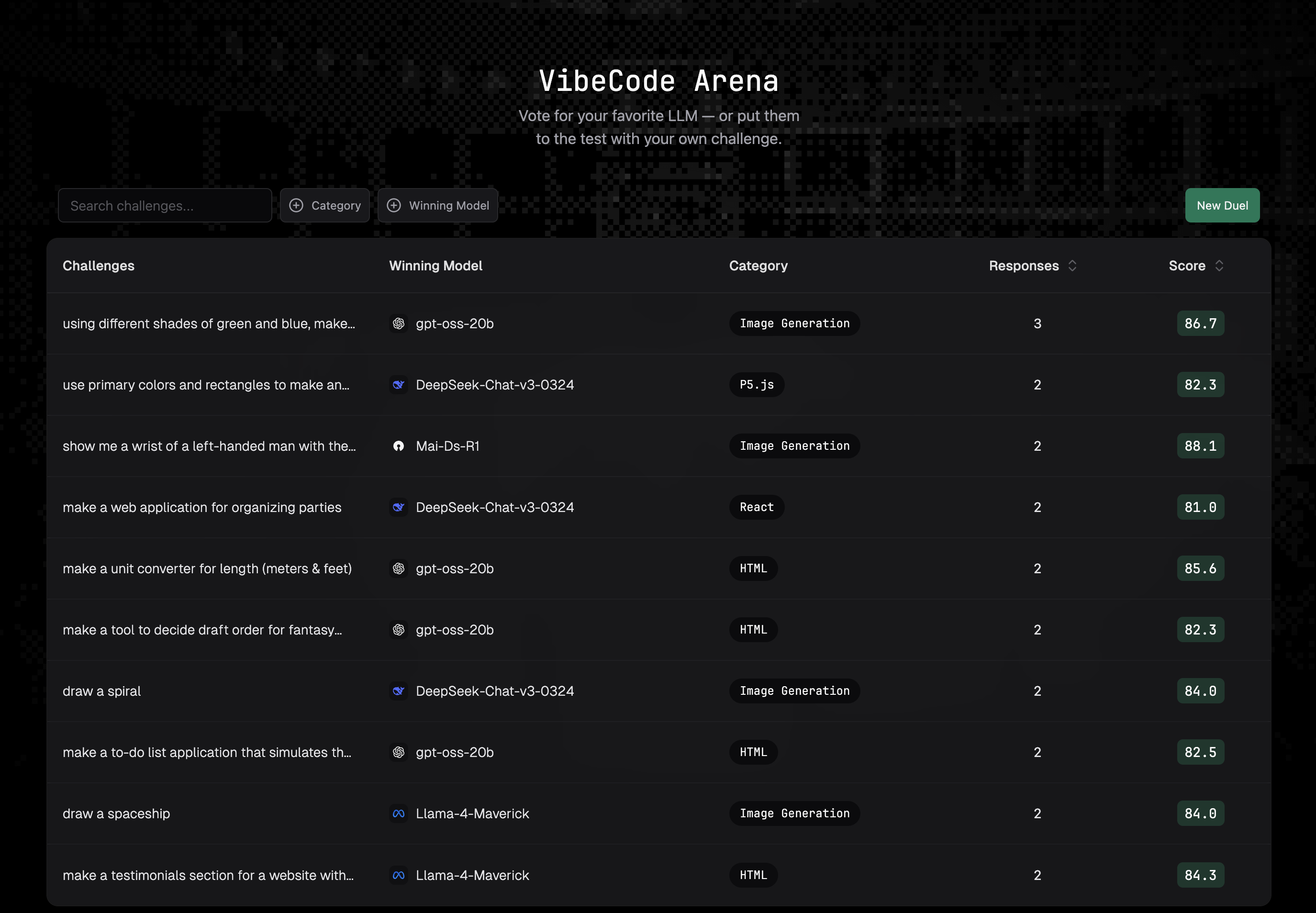
Within seconds, I had code from multiple LLMs, including DeepSeek, Mistral, GPT, and Llama. Each code sample also had an objective evaluation score. I was pleasantly surprised to see so many solutions for the same problem. I picked gpt-oss-20b model from OpenAI. For this experiment, I wanted to focus on learning how to code better so either one of the LLMs could have worked. But VibeCodeArena can also be used to evaluate different LLMs to help make a decision about which model to use for what problem statement.
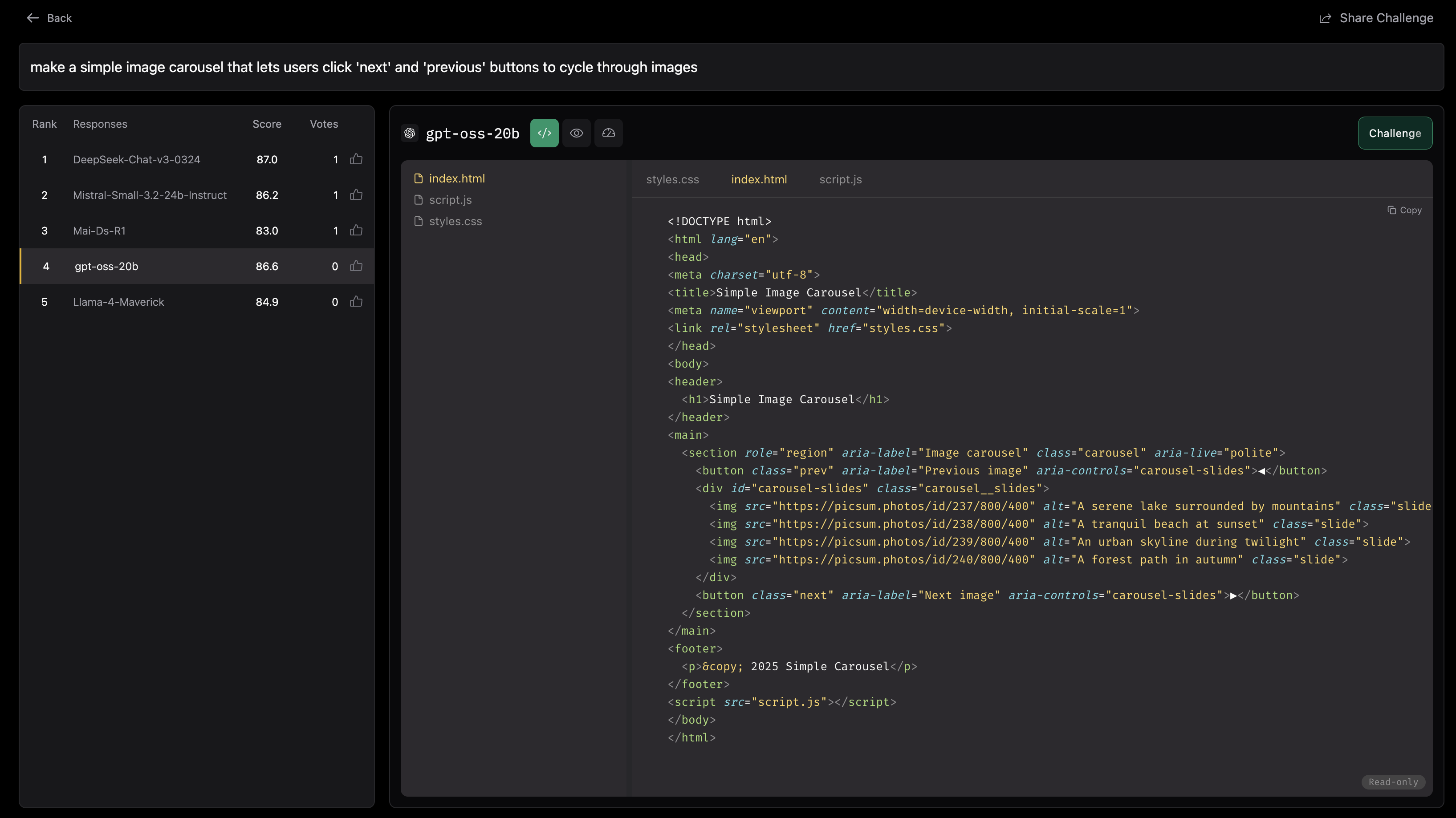
The model had produced a clean HTML, CSS, and JavaScript. The code looked professional. I could see the preview of the code by clicking on the render icon. It worked perfectly in my browser. The carousel was smooth, and the images loaded beautifully.
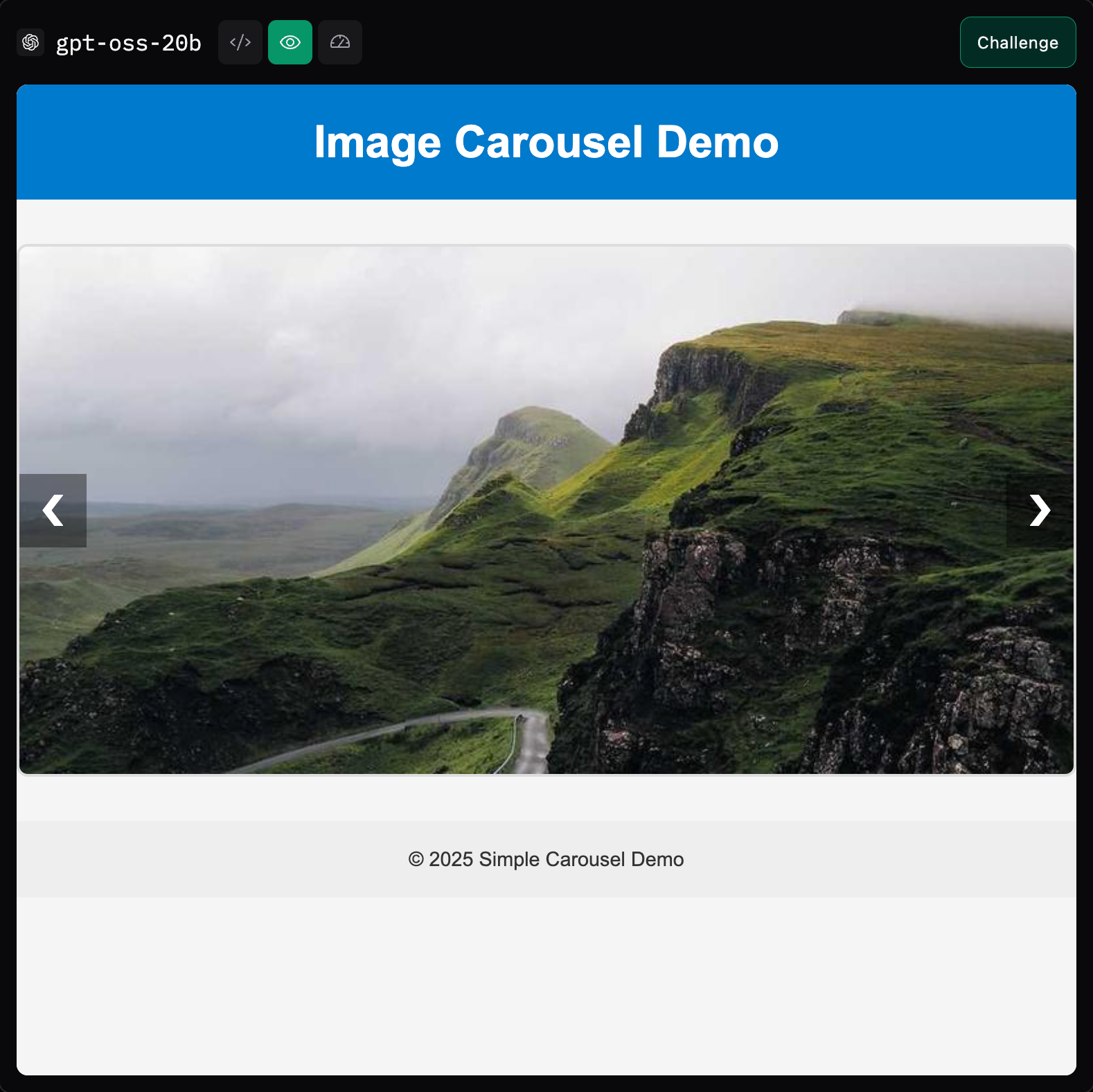
But was it actually good code?

I had no idea. That's when I decided to look at the evaluation metrics

What I Thought Was "Good Code"

A working image carousel with:

  • Clean, semantic HTML
  • Smooth CSS transitions
  • Keyboard navigation support
  • ARIA labels for accessibility
  • Error handling for failed images

It looked like something a senior developer would write. But I had questions:

Was it secure? Was it optimized? Would it scale? Were there better ways to structure it?

Without objective evaluation, I had no answers. So, I proceeded to look at the detailed evaluation metrics for this code
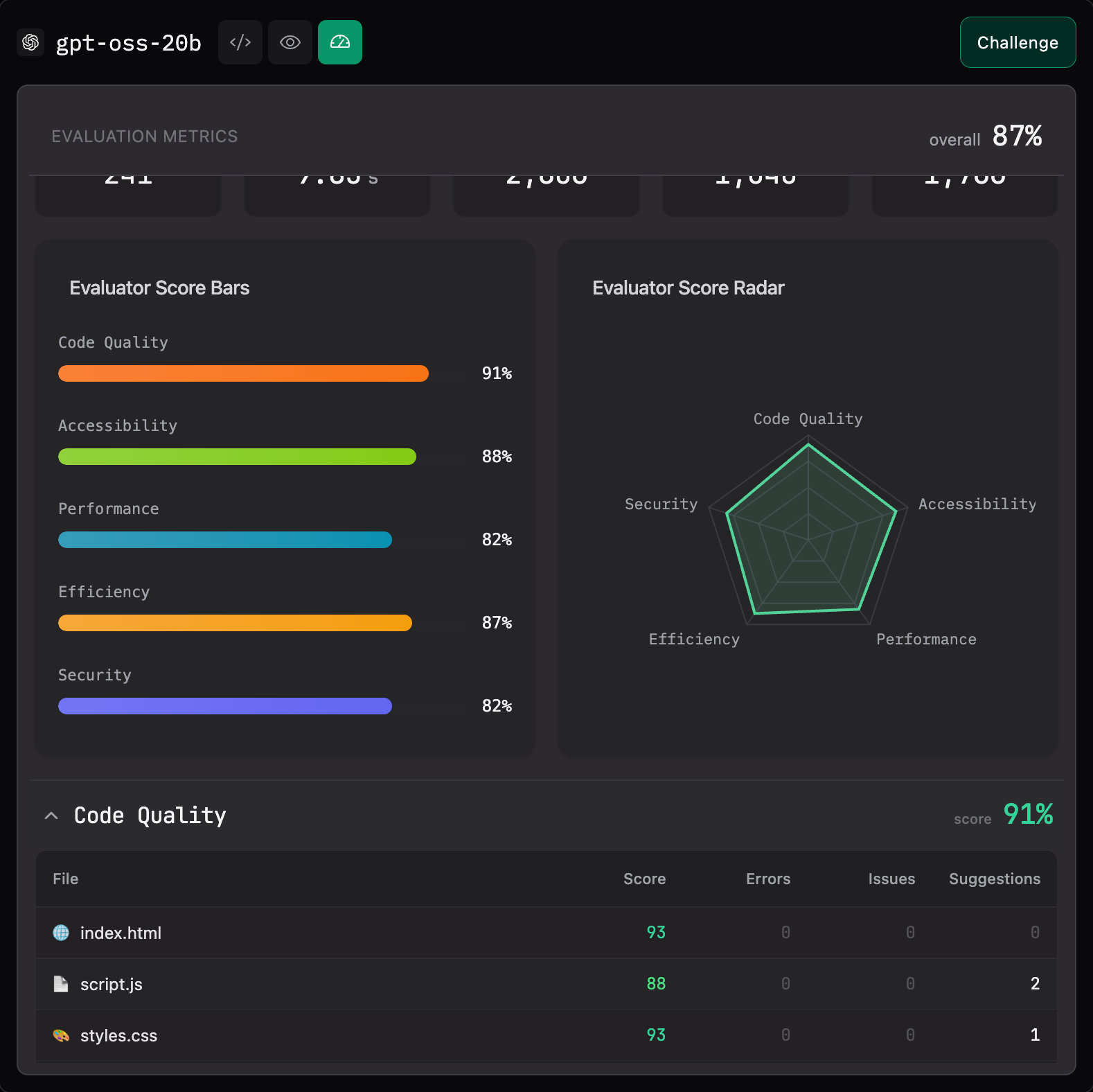
What VibeCodeArena's Evaluation Showed

The platform's objective evaluation revealed issues I never would have spotted:

Security Vulnerabilities (The Scary Ones)

No Content Security Policy (CSP): My carousel was wide open to XSS attacks. Anyone could inject malicious scripts through the image URLs or manipulate the DOM. VibeCodeArena flagged this immediately and recommended implementing CSP headers.

Missing Input Validation: The platform pointed out that while the code handles image errors, it doesn't validate or sanitize the image sources. A malicious actor could potentially exploit this.

Hardcoded Configuration: Image URLs and settings were hardcoded directly in the code. The platform recommended using environment variables instead - a best practice I completely overlooked.

SQL Injection Vulnerability Patterns: Even though this carousel doesn't use a database, the platform flagged coding patterns that could lead to SQL injection in similar contexts. This kind of forward-thinking analysis helps prevent copy-paste security disasters.

Performance Problems (The Silent Killers)

DOM Structure Depth (15 levels): VibeCodeArena measured my DOM at 15 levels deep. I had no idea. This creates unnecessary rendering overhead that would get worse as the carousel scales.

Expensive DOM Queries: The JavaScript was repeatedly querying the DOM without caching results. Under load, this would create performance bottlenecks I'd never notice in local testing.

Missing Performance Optimizations: The platform provided a checklist of optimizations I didn't even know existed:

  • No DNS-prefetch hints for external image domains
  • Missing width/height attributes causing layout shift
  • No preload directives for critical resources
  • Missing CSS containment properties
  • No will-change property for animated elements

Each of these seems minor, but together they compound into a poor user experience.

Code Quality Issues (The Technical Debt)

High Nesting Depth (4 levels): My JavaScript had logic nested 4 levels deep. VibeCodeArena flagged this as a maintainability concern and suggested flattening the logic.

Overly Specific CSS Selectors (depth: 9): My CSS had selectors 9 levels deep, making it brittle and hard to refactor. I thought I was being thorough; I was actually creating maintenance nightmares.

Code Duplication (7.9%): The platform detected nearly 8% code duplication across files. That's technical debt accumulating from day one.

Moderate Maintainability Index (67.5): While not terrible, the platform showed there's significant room for improvement in code maintainability.

Missing Best Practices (The Professional Touches)

The platform also flagged missing elements that separate hobby projects from professional code:

  • No 'use strict' directive in JavaScript
  • Missing package.json for dependency management
  • No test files
  • Missing README documentation
  • No .gitignore or version control setup
  • Could use functional array methods for cleaner code
  • Missing CSS animations for enhanced UX

The "Aha" Moment

Here's what hit me: I had no framework for evaluating code quality beyond "does it work?"

The carousel functioned. It was accessible. It had error handling. But I couldn't tell you if it was secure, optimized, or maintainable.

VibeCodeArena gave me that framework. It didn't just point out problems, it taught me what production-ready code looks like.

My New Workflow: The Learning Loop

This is when I discovered the real power of the platform. Here's my process now:

Step 1: Generate Code Using VibeCodeArena

I start with a prompt and let the AI generate the initial solution. This gives me a working baseline.

Step 2: Analyze Across Several Metrics

I can get comprehensive analysis across:

  • Security vulnerabilities
  • Performance/Efficiency issues
  • Performance optimization opportunities
  • Code Quality improvements

This is where I learn. Each issue includes explanation of why it matters and how to fix it.

Step 3: Click "Challenge" and Improve

Here's the game-changer: I click the "Challenge" button and start fixing the issues based on the suggestions. This turns passive reading into active learning.

Do I implement CSP headers correctly? Does flattening the nested logic actually improve readability? What happens when I add dns-prefetch hints?

I can even use AI to help improve my code. For this action, I can use from a list of several available models that don't need to be the same one that generated the code. This helps me to explore which models are good at what kind of tasks.

For my experiment, I decided to work on two suggestions provided by VibeCodeArena by preloading critical CSS/JS resources with <link rel="preload"> for faster rendering in index.html and by adding explicit width and height attributes to images to prevent layout shift in index.html. The code editor gave me change summary before I submitted by code for evaluation.
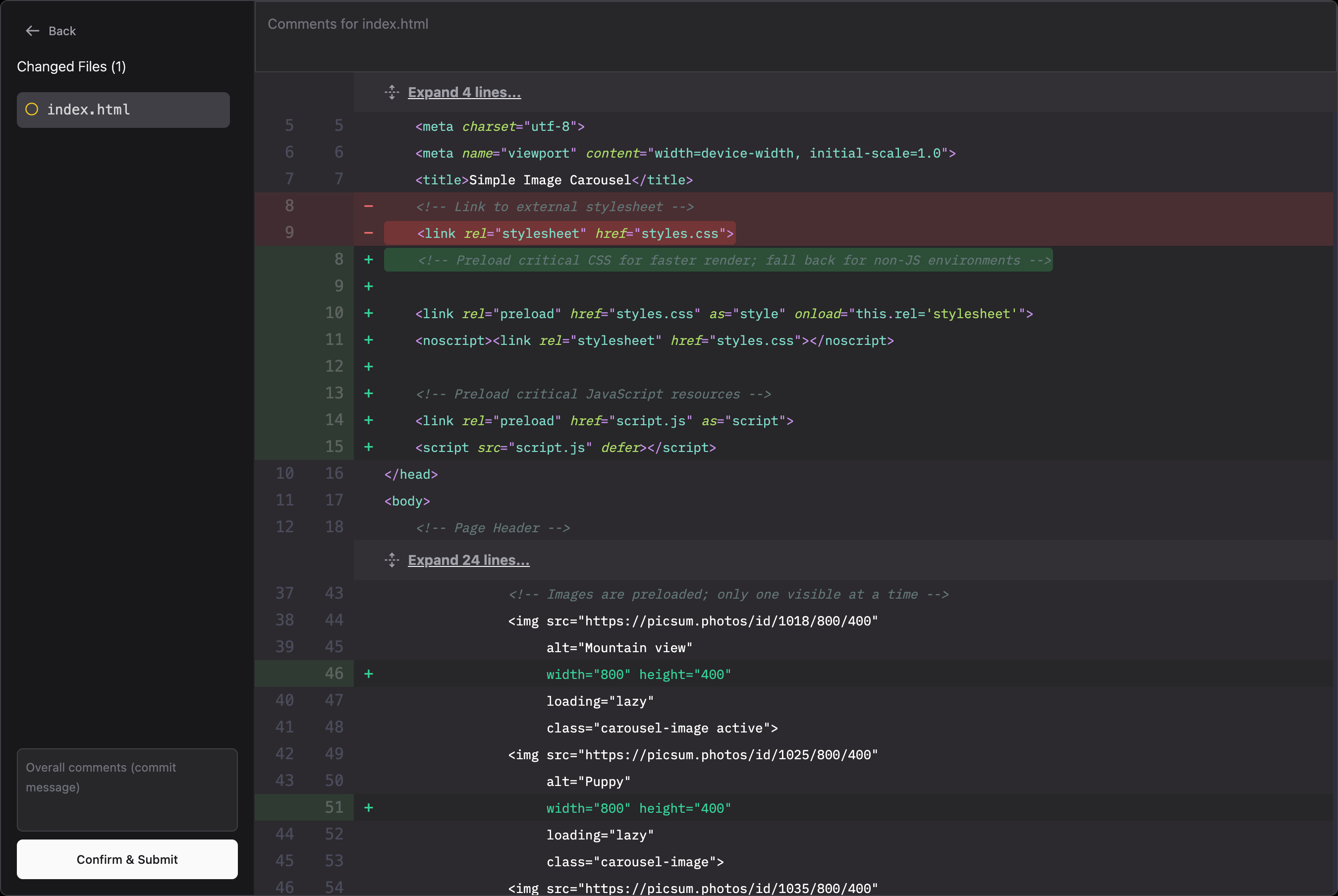
Step 4: Submit for Evaluation

After making improvements, I submit my code for evaluation. Now I see:

  • What actually improved (and by how much)
  • What new issues I might have introduced
  • Where I still have room to grow

Step 5: Hey, I Can Beat AI

My changes helped improve the performance metric of this simple code from 82% to 83% - Yay! But this was just one small change. I now believe that by acting upon multiple suggestions, I can easily improve the quality of the code that I write versus just relying on prompts.

Each improvement can move me up the leaderboard. I'm not just learning in isolation—I'm seeing how my solutions compare to other developers and AI models.

So, this is the loop: Generate → Analyze → Challenge → Improve → Measure → Repeat.

Every iteration makes me better at both evaluating AI code and writing better prompts.
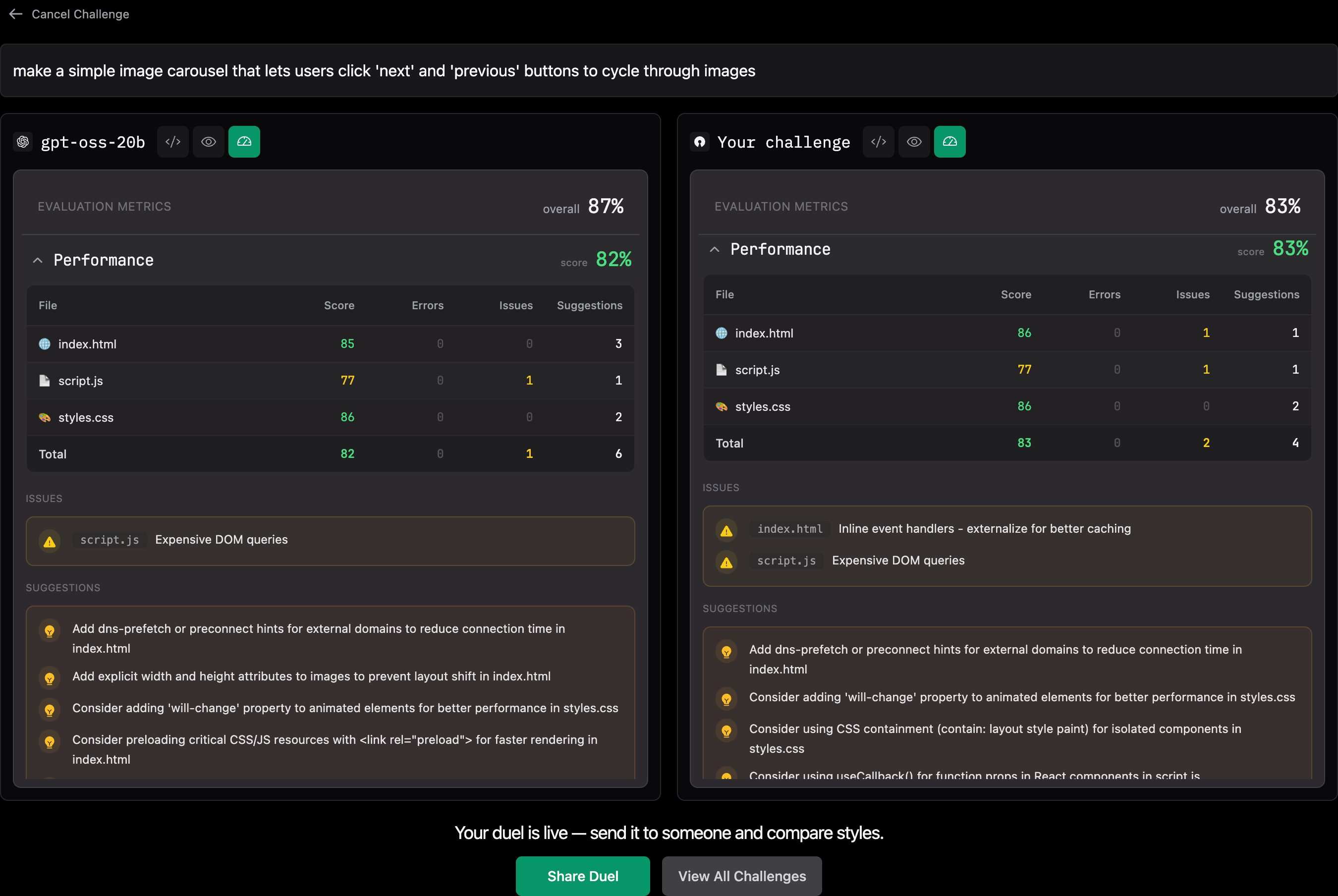
What This Means for Learning to Code with AI

This experience taught me three critical lessons:

1. Working ≠ Good Code

AI models are incredible at generating code that functions. But "it works" tells you nothing about security, performance, or maintainability.

The gap between "functional" and "production-ready" is where real learning happens. VibeCodeArena makes that gap visible and teachable.

2. Improvement Requires Measurement

I used to iterate on code blindly: "This seems better... I think?"

Now I know exactly what improved. When I flatten nested logic, I see the maintainability index go up. When I add CSP headers, I see security scores improve. When I optimize selectors, I see performance gains.

Measurement transforms vague improvement into concrete progress.

3. Competition Accelerates Learning

The leaderboard changed everything for me. I'm not just trying to write "good enough" code—I'm trying to climb past other developers and even beat the AI models.

This competitive element keeps me pushing to learn one more optimization, fix one more issue, implement one more best practice.

How the Platform Helps Me Become A Better Programmer

VibeCodeArena isn't just an evaluation tool—it's a structured learning environment. Here's what makes it effective:

Immediate Feedback: I see issues the moment I submit code, not weeks later in code review.

Contextual Education: Each issue comes with explanation and guidance. I learn why something matters, not just that it's wrong.

Iterative Improvement: The "Challenge" button transforms evaluation into action. I learn by doing, not just reading.

Measurable Progress: I can track my improvement over time—both in code quality scores and leaderboard position.

Comparative Learning: Seeing how my solutions stack up against others shows me what's possible and motivates me to reach higher.

What I've Learned So Far

Through this iterative process, I've gained practical knowledge I never would have developed just reading documentation:

  • How to implement Content Security Policy correctly
  • Why DOM depth matters for rendering performance
  • What CSS containment does and when to use it
  • How to structure code for better maintainability
  • Which performance optimizations actually make a difference

Each "Challenge" cycle teaches me something new. And because I'm measuring the impact, I know what actually works.

The Bottom Line

AI coding tools are incredible for generating starting points. But they don't produce high quality code and can't teach you what good code looks like or how to improve it.

VibeCodeArena bridges that gap by providing:

✓ Objective analysis that shows you what's actually wrong
✓ Educational feedback that explains why it matters
✓ A "Challenge" system that turns learning into action
✓ Measurable improvement tracking so you know what works
✓ Competitive motivation through leaderboards

My "simple image carousel" taught me an important lesson: The real skill isn't generating code with AI. It's knowing how to evaluate it, improve it, and learn from the process.

The future of AI-assisted development isn't just about prompting better. It's about developing the judgment to make AI-generated code production-ready. That requires structured learning, objective feedback, and iterative improvement. And that's exactly what VibeCodeArena delivers.

Here is a link to the code for the image carousal I used for my learning journey

#AIcoding #WebDevelopment #CodeQuality #VibeCoding #SoftwareEngineering #LearningToCode

Vibe Coding: Shaping the Future of Software

A New Era of Code Vibe coding is a new method of using natural language prompts and AI tools to generate code. I have seen firsthand that this change Discover how vibe coding is reshaping software development. Learn about its benefits, challenges, and what it means for developers in the AI era.
Author
Vishwastam Shukla
Calendar Icon
November 8, 2025
Timer Icon
3 min read

A New Era of Code

Vibe coding is a new method of using natural language prompts and AI tools to generate code. I have seen firsthand that this change makes software more accessible to everyone. In the past, being able to produce functional code was a strong advantage for developers. Today, when code is produced quickly through AI, the true value lies in designing, refining, and optimizing systems. Our role now goes beyond writing code; we must also ensure that our systems remain efficient and reliable.

From Machine Language to Natural Language

I recall the early days when every line of code was written manually. We progressed from machine language to high-level programming, and now we are beginning to interact with our tools using natural language. This development does not only increase speed but also changes how we approach problem solving. Product managers can now create working demos in hours instead of weeks, and founders have a clearer way of pitching their ideas with functional prototypes. It is important for us to rethink our role as developers and focus on architecture and system design rather than simply on typing c

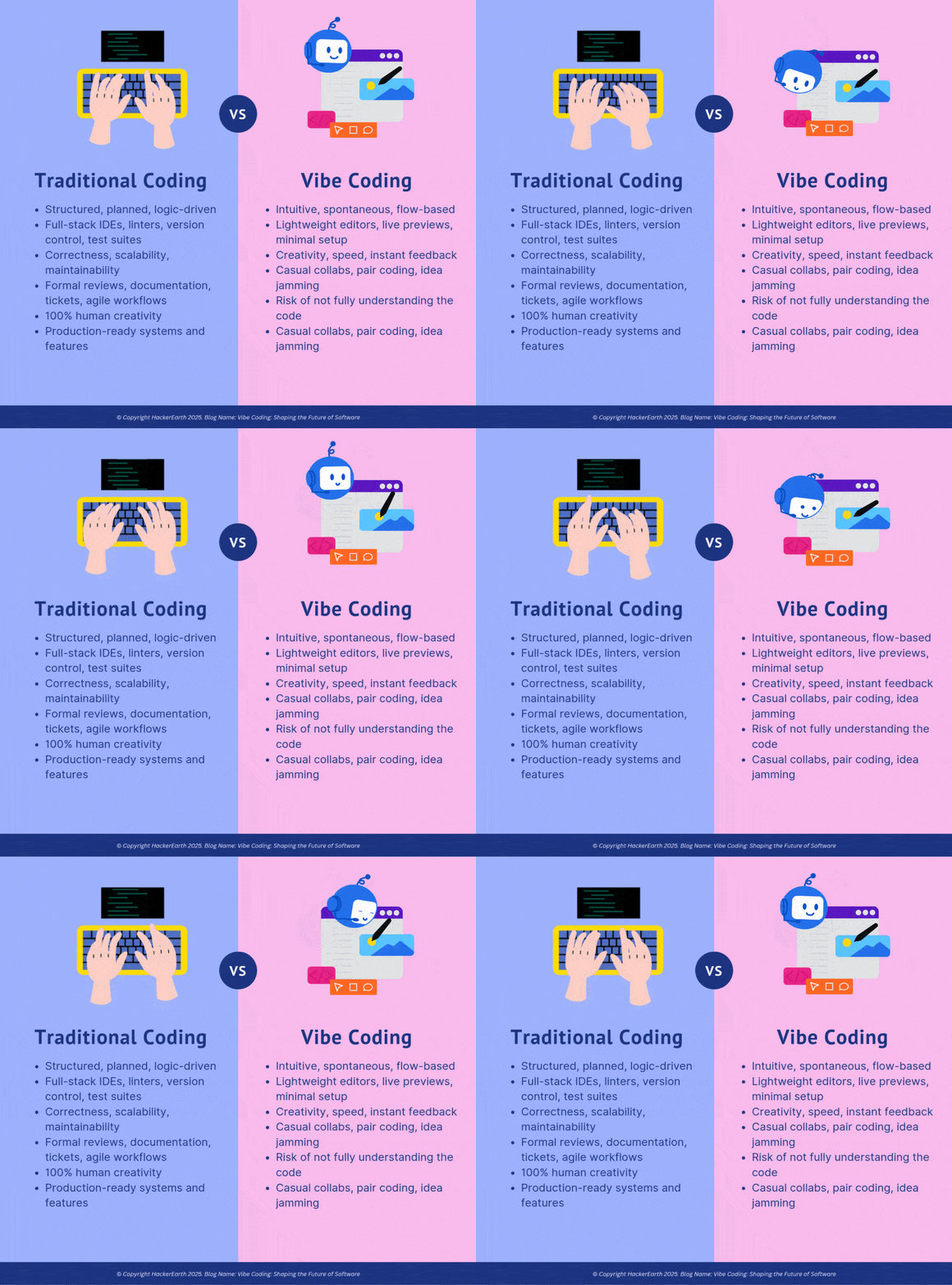
Vibe Coding Difference

The Promise and the Pitfalls

I have experienced both sides of vibe coding. In cases where the goal was to build a quick prototype or a simple internal tool, AI-generated code provided impressive results. Teams have been able to test new ideas and validate concepts much faster. However, when it comes to more complex systems that require careful planning and attention to detail, the output from AI can be problematic. I have seen situations where AI produces large volumes of code that become difficult to manage without significant human intervention.

AI-powered coding tools like GitHub Copilot and AWS’s Q Developer have demonstrated significant productivity gains. For instance, at the National Australia Bank, it’s reported that half of the production code is generated by Q Developer, allowing developers to focus on higher-level problem-solving . Similarly, platforms like Lovable or Hostinger Horizons enable non-coders to build viable tech businesses using natural language prompts, contributing to a shift where AI-generated code reduces the need for large engineering teams. However, there are challenges. AI-generated code can sometimes be verbose or lack the architectural discipline required for complex systems. While AI can rapidly produce prototypes or simple utilities, building large-scale systems still necessitates experienced engineers to refine and optimize the code.​

The Economic Impact

The democratization of code generation is altering the economic landscape of software development. As AI tools become more prevalent, the value of average coding skills may diminish, potentially affecting salaries for entry-level positions. Conversely, developers who excel in system design, architecture, and optimization are likely to see increased demand and compensation.​
Seizing the Opportunity

Vibe coding is most beneficial in areas such as rapid prototyping and building simple applications or internal tools. It frees up valuable time that we can then invest in higher-level tasks such as system architecture, security, and user experience. When used in the right context, AI becomes a helpful partner that accelerates the development process without replacing the need for skilled engineers.

This is revolutionizing our craft, much like the shift from machine language to assembly to high-level languages did in the past. AI can churn out code at lightning speed, but remember, “Any fool can write code that a computer can understand. Good programmers write code that humans can understand.” Use AI for rapid prototyping, but it’s your expertise that transforms raw output into robust, scalable software. By honing our skills in design and architecture, we ensure our work remains impactful and enduring. Let’s continue to learn, adapt, and build software that stands the test of time.​

Ready to streamline your recruitment process? Get a free demo to explore cutting-edge solutions and resources for your hiring needs.

How Candidates Use Technology to Cheat in Online Technical Assessments

Discover common technologies used by candidates for cheating in online assessments. Explore effective prevention methods like proctoring, AI monitoring, and smart test formats.
Author
Nischal V Chadaga
Calendar Icon
December 1, 2025
Timer Icon
3 min read

Impact of Online Assessments in Technical Hiring


In a digitally-native hiring landscape, online assessments have proven to be both a boon and a bane for recruiters and employers.

The ease and efficiency of virtual interviews, take home programming tests and remote coding challenges is transformative. Around 82% of companies use pre-employment assessments as reliable indicators of a candidate's skills and potential.

Online skill assessment tests have been proven to streamline technical hiring and enable recruiters to significantly reduce the time and cost to identify and hire top talent.

In the realm of online assessments, remote assessments have transformed the hiring landscape, boosting the speed and efficiency of screening and evaluating talent. On the flip side, candidates have learned how to use creative methods and AI tools to cheat in tests.

As it turns out, technology that makes hiring easier for recruiters and managers - is also their Achilles' heel.

Cheating in Online Assessments is a High Stakes Problem


With the proliferation of AI in recruitment, the conversation around cheating has come to the forefront, putting recruiters and hiring managers in a bit of a flux.


According to research, nearly 30 to 50 percent of candidates cheat in online assessments for entry level jobs. Even 10% of senior candidates have been reportedly caught cheating.

The problem becomes twofold - if finding the right talent can be a competitive advantage, the consequences of hiring the wrong one can be equally damaging and counter-productive.

As per Forbes, a wrong hire can cost a company around 30% of an employee's salary - not to mention, loss of precious productive hours and morale disruption.

The question that arises is - "Can organizations continue to leverage AI-driven tools for online assessments without compromising on the integrity of their hiring process? "

This article will discuss the common methods candidates use to outsmart online assessments. We will also dive deep into actionable steps that you can take to prevent cheating while delivering a positive candidate experience.

Common Cheating Tactics and How You Can Combat Them


  1. Using ChatGPT and other AI tools to write code

    Copy-pasting code using AI-based platforms and online code generators is one of common cheat codes in candidates' books. For tackling technical assessments, candidates conveniently use readily available tools like ChatGPT and GitHub. At the same time, some organizations complement their process with context-aware code security support to ensure AI-generated solutions follow secure development practices. Using these tools, candidates can easily generate solutions to solve common programming challenges such as:
    • Debugging code
    • Optimizing existing code
    • Writing problem-specific code from scratch
    Ways to prevent it
    • Enable full-screen mode
    • Disable copy-and-paste functionality
    • Restrict tab switching outside of code editors
    • Use AI to detect code that has been copied and pasted
  2. Enlist external help to complete the assessment


    Candidates often seek out someone else to take the assessment on their behalf. In many cases, they also use screen sharing and remote collaboration tools for real-time assistance.

    In extreme cases, some candidates might have an off-camera individual present in the same environment for help.

    Ways to prevent it
    • Verify a candidate using video authentication
    • Restrict test access from specific IP addresses
    • Use online proctoring by taking snapshots of the candidate periodically
    • Use a 360 degree environment scan to ensure no unauthorized individual is present
  3. Using multiple devices at the same time


    Candidates attempting to cheat often rely on secondary devices such as a computer, tablet, notebook or a mobile phone hidden from the line of sight of their webcam.

    By using multiple devices, candidates can look up information, search for solutions or simply augment their answers.

    Ways to prevent it
    • Track mouse exit count to detect irregularities
    • Detect when a new device or peripheral is connected
    • Use network monitoring and scanning to detect any smart devices in proximity
    • Conduct a virtual whiteboard interview to monitor movements and gestures
  4. Using remote desktop software and virtual machines


    Tech-savvy candidates go to great lengths to cheat. Using virtual machines, candidates can search for answers using a secondary OS while their primary OS is being monitored.

    Remote desktop software is another cheating technique which lets candidates give access to a third-person, allowing them to control their device.

    With remote desktops, candidates can screen share the test window and use external help.

    Ways to prevent it
    • Restrict access to virtual machines
    • AI-based proctoring for identifying malicious keystrokes
    • Use smart browsers to block candidates from using VMs

Future-proof Your Online Assessments With HackerEarth

HackerEarth's AI-powered online proctoring solution is a tested and proven way to outsmart cheating and take preventive measures at the right stage. With HackerEarth's Smart Browser, recruiters can mitigate the threat of cheating and ensure their online assessments are accurate and trustworthy.
  • Secure, sealed-off testing environment
  • AI-enabled live test monitoring
  • Enterprise-grade, industry leading compliance
  • Built-in features to track, detect and flag cheating attempts
Boost your hiring efficiency and conduct reliable online assessments confidently with HackerEarth's revolutionary Smart Browser.

Talent Acquisition Strategies For Rehiring Former Employees

Discover effective talent acquisition strategies for rehiring former employees. Learn how to attract, evaluate, and retain top boomerang talent to strengthen your workforce.
Author
Nischal V Chadaga
Calendar Icon
November 8, 2025
Timer Icon
3 min read
Former employees who return to work with the same organisation are essential assets. In talent acquisition, such employees are also termed as ‘Boomerang employees’. Former employees are valuable because they require the least training and onboarding because of their familiarity with the organization’s policies. Rehiring former employees by offering them more perks is a mark of a successful hiring process. This article will elaborate on the talent acquisition strategies for rehiring former employees, supported by a few real-life examples and best practices.

Why Should Organizations Consider Rehiring?

One of the best ways of ensuring quality hire with a low candidate turnover is to deploy employee retention programs like rehiring female professionals who wish to return to work after a career break. This gives former employees a chance to prove their expertise while ensuring them the organization’s faith in their skills and abilities. Besides, seeing former employees return to their old organizations encourages newly appointed employees to be more productive and contribute to the overall success of the organization they are working for. A few other benefits of rehiring old employees are listed below.

Reduced Hiring Costs

Hiring new talent incurs a few additional costs. For example, tasks such as sourcing resumes of potential candidates, reaching out to them, conducting interviews and screenings costs money to the HR department. Hiring former employees cuts down these costs and aids a seamless transition process for them.

Faster Onboarding

Since boomerang employees are well acquainted with the company’s onboarding process, they don’t have to undergo the entire exercise. A quick, one-day session informing them of any recent changes in the company’s work policies is sufficient to onboard them.

Retention of Knowledge

As a former employee, rehired executives have knowledge of the previous workflows and insights from working on former projects. This can be valuable in optimizing a current project. They bring immense knowledge and experience with them which can be instrumental in driving new projects to success.Starbucks is a prime example of a company that has successfully leveraged boomerang employees. Howard Schultz, the company's CEO, left in 2000 but returned in 2008 during a critical time for the firm. His leadership was instrumental in revitalizing the brand amid financial challenges.

Best Practices for Rehiring Former Employees

Implementing best practices is the safest way to go about any operation. Hiring former employees can be a daunting task especially if it involves someone who was fired previously. It is important to draft certain policies around rehiring former employees. Here are a few of them that can help you to get started.

1. Create a Clear Rehire Policy

While considering rehiring a former employee, it is essential to go through data indicating the reason why they had to leave in the first place. Any offer being offered must supersede their previous offer while marking clear boundaries to maintain work ethics. Offer a fair compensation that justifies their skills and abilities which can be major contributors to the success of the organization. A well-defined policy not only streamlines the rehiring process but also promotes fairness within the organization.

2. Conduct Thorough Exit Interviews

Exit interviews provide valuable insights into why employees leave and can help maintain relationships for potential future rehires. Key aspects to cover include:
  • Reasons for departure.
  • Conditions under which they might consider returning.
  • Feedback on organizational practices.
Keeping lines of communication open during these discussions can foster goodwill and encourage former employees to consider returning when the time is right.

3. Maintain Connections with Alumni

Creating and maintaining an alumni association must be an integral part of HR strategies. This exercise ensures that the HR department can find former employees in times of dire need and indicates to former employees how the organization is vested in their lives even after they have left them. This gesture fosters a feeling of goodwill and gratitude among former hires. Alumni networks and social media groups help former employees stay in touch with each other, thus improving their interpersonal communication.Research indicates that about 15% of rehired employees return because they maintained connections with their former employers.

4. Assess Current Needs Before Reaching Out

Before reaching out to former employees, assess all viable options and list out the reasons why rehiring is inevitable. Consider:
  • Changes in job responsibilities since their departure.
  • Skills or experiences gained by other team members during their absence.
It is essential to understand how the presence of a boomerang employee can be instrumental in solving professional crises before contacting them. It is also important to consider their present circumstances.

5. Initiate an Honest Conversation

When you get in touch with a former employee, it is important to understand their perspective on the job being offered. Make them feel heard and empathize with any difficult situations they may have had to face during their time in the organization. Understand why they would consider rejoining the company. These steps indicate that you truly care about them and fosters a certain level of trust between them and the organization which can motivate them to rejoin with a positive attitude.

6. Implement a Reboarding Program

When a former employee rejoins, HR departments must ensure a robust reboarding exercise is conducted to update them about any changes within the organization regarding the work policies and culture changes, training them about any new tools or systems that were deployed during their absence and allowing them time to reconnect with old team members or acquaint with new ones.

7. Make Them Feel Welcome

Creating a welcoming environment is essential for helping returning employees adjust smoothly. Consider:
  • Organizing team lunches or social events during their first week.
  • Assigning a mentor or buddy from their previous team to help them reacclimate.
  • Providing resources that facilitate learning about any organizational changes.
A positive onboarding experience reinforces their decision to return and fosters loyalty.

Real-Life Examples of Successful Rehiring

Several companies have successfully implemented these strategies:

IBM: The tech giant has embraced boomerang hiring by actively reaching out to former employees who possess critical skills in emerging technologies. IBM has found that these individuals often bring fresh perspectives that contribute significantly to innovation7.

Zappos: Known for its strong company culture, Zappos maintains an alumni network that keeps former employees engaged with the brand. This connection has led to numerous successful rehiring instances, enhancing both morale and productivity within teams6.

Conclusion

Rehiring former employees can provide organizations with unique advantages, including reduced costs, quicker onboarding, and retained knowledge. By implementing strategic practices—such as creating clear policies, maintaining connections, assessing current needs, and fostering welcoming environments—companies can effectively tap into this valuable talent pool.

As organizations continue navigating an ever-changing workforce landscape, embracing boomerang employees may be key to building resilient teams equipped for future challenges. By recognizing the potential benefits and following best practices outlined above, businesses can create a robust strategy for rehiring that enhances both employee satisfaction and organizational performance.
Arrow Left
Arrow right
Tech Hiring Insights

HackerEarth Blogs

Gain insights to optimize your developer recruitment process.
Clear all
Thank you! Your submission has been received!
Oops! Something went wrong while submitting the form.
Filter
Filter

Top 7 Online Coding Interview Platforms in 2026

When you’re gearing up for a technical interview in recent times, practicing on the right platforms can help you make it or break the interview. 

Today’s job market moves fast, and hiring teams expect coding candidates to think clearly, write clean solutions, and perform under pressure. Online platforms have stepped up to meet that need. They give you real coding problems to solve, timed environments that mimic live interviews, and some even let you run mock interviews with real people. 

In fact, about 60% of companies now use online assessment platforms to evaluate technical skills during remote hiring, including live coding and automated grading, making online coding interview platforms a core part of developer recruitment. Whether you want to drill data structures, simulate live coding screens, or just practice coding interview questions again and again, there’s a tool designed for that. 

In this article, we break down the top 7 online coding interview platforms that will help you practice smarter, stay confident, and land the job you’re aiming for.

The 10 Best Online Coding Interview Tools: A Side-by-Side Comparison

This table provides a side-by-side comparison of the top online coding platforms for interview use, highlighting essential features, strengths, and use cases. 

It helps recruiters and hiring teams quickly evaluate each online coding platform's interview performance, so you can identify the right solution for your technical hiring needs.

Tool Name Best for (Use Case) Key Features Pros Cons G2 Rating
HackerEarth FaceCode Best overall online coding interview platform Live pair programming, extensive question library, AI-powered interview agent, smart browser proctoring, global hackathons, enterprise integrations, and reliable uptime End-to-end collaborative interviews; AI summaries; strong proctoring; vast question library; GDPR & ISO compliance Limited deep customization; no stripped-down budget plans 4.5
CoderPad Best for real-time collaborative coding Private interviewer notes, multi-language support, closed captioning, waiting room, ATS integrations Highly intuitive and smooth real-time collaboration; “no setup” candidate experience; robust multi-language support Basic UI; limited advanced editor/debug features; focused primarily on live interviews 4.4
Codility Best for enterprise technical assessments AI collaboration assessment, seamless collaboration tools, and a standardized process Live coding + pair programming + whiteboard; AI integration; accessible candidate experience SQL tasks can be awkward; some contexts need manual setup; fewer custom task options 4.6
HireHunch (HunchVue) Best for AI-assisted screening Multi-language support, interview playback, proctoring alerts, unified dashboard Robust playback and review; proctoring alerts; customizable templates Free plan time caps; learning curve for setups; potential additional costs 4.6
PlayCode Best lightweight browser coding tool Instant link interviews, multi-file projects, real-time collaboration, AI assistant No signup needed; AI help & bug detection; fast browser preview Free tier limits can frustrate; limited advanced IDE features N/A
Mercer Mettl Best for campus & large-scale hiring Seamless pair programming, role-based assessments, digital ideation, code analysis, hackathons Scales for campus/enterprise hiring; project-based evaluations; auto-graded simulators Higher pricing for smaller teams; some advanced tools require training; limited deep reports 4.4
iMocha Best for skill intelligence Skills library access, insights & benchmarking, AI-SkillsMatch, Tara AI interviews, secure proctoring AI-powered insights & scoring; secure assessments; adaptive AI interviews Learning curve; test setup can be unintuitive; advanced reporting can need extra configuration 4.4

How We Evaluated These Online Coding Interview Platforms

Most online coding interview tools promise faster hiring and a better signal. Very few prove it under real technical scrutiny. 

To separate marketing claims from measurable value, we evaluated each tool against the standards modern engineering teams actually require today.

  • Live coding collaboration quality: We assessed how well each platform supports real-time collaboration between the interviewer and the candidate. Then, we looked for smooth code sharing, low-latency performance, and features such as cursor visibility, code playback, and collaborative debugging that reflect real development workflows.
  • Multi-language support: Engineering teams rarely hire for just one language. Hence, it’s not practical for them to run separate platforms for Python, Java, JavaScript, Go, or Rust. If teams switch tools, it fragments workflows, increases cost, and creates inconsistent candidate experiences. Robust online coding interview platforms provide deep, reliable execution environments across both popular and niche languages.
  • IDE and environment realism: We also examined how closely each built-in IDE replicates production setups, including debugging tools, terminal access, dependency management, and configuration flexibility. The closer the environment is to real-world engineering conditions, the stronger the hiring signal.
  • Question bank depth: If technology evolves quickly, your interview questions must evolve even faster. At the same time, widely circulated questions lose their effectiveness when candidates memorize answers from forums or online interview-coding practice sites. High-performing platforms provide role-specific libraries across frontend, backend, data, DevOps, and system design.
  • Structured evaluation rubrics: Consistency reduces bias. Platforms that enforce standardized scoring frameworks make it easier for hiring teams to compare candidates objectively. Clear rubrics also improve interviewer alignment and support more defensible hiring decisions.
  • Anti-cheating and integrity safeguards: What use is a coding interview platform if it cannot detect cheating? Hence, we evaluated plagiarism detection, proctoring features, browser monitoring, copy-paste controls, and suspicious behavior tracking. 
  • Enterprise integrations: Modern hiring teams operate within complex recruitment ecosystems. This is why we reviewed ATS compatibility, single sign-on support, API flexibility, and workflow automation. 
  • Reporting and analytics: We examined score breakdowns, performance benchmarking, and interviewer insights. In-depth analytics support faster and more confident hiring decisions.
  • Candidate experience: Every interview reflects your employer brand. Interface clarity, platform stability, accessibility, and overall usability all shape how candidates perceive your company. A frictionless experience increases completion rates and leaves a lasting positive impression.
  • Pricing transparency: Finally, we reviewed pricing clarity, scalability across team sizes, and the risk of hidden costs. Transparent pricing supports predictable hiring budgets.

The 7 Best Online Coding Interview Tools: An In-Depth Comparison

After testing and comparing a wide range of platforms, we selected the 7 best online coding interview tools that combine real-world coding environments, seamless collaboration, and more, to help candidates and hiring teams succeed.

1. HackerEarth FaceCode: Best overall online coding interview platform

Conduct efficient live coding interviews with HackerEarth FaceCode
Make smarter, faster hiring decisions with FaceCode

As an all-in-one online coding assessment platform, HackerEarth allows hiring teams to assess candidates’ coding abilities, problem-solving skills, and communication in real time, moving beyond static tests or traditional resume filters. Its FaceCode tool provides a state-of-the-art collaborative code editor, HD video chat, interactive diagram boards for system design, and a built-in library of over 40,000 questions. Teams can conduct live panel interviews with up to five interviewers in one session to assess a candidate’s coding skills, problem-solving, and collaboration abilities.

The AI-powered interview agent automates structured interview conversations based on predefined rubrics, adapts to candidate responses, and generates unbiased scoring. FaceCode stores full interview recordings and transcripts for later review, and masking personally identifiable information ensures fair assessments.

FaceCode integrates with ATS platforms such as Greenhouse, Lever, Workday, and SAP. It is GDPR-compliant, ISO 27001-certified, and maintains 99.99% uptime, making it reliable for both small- and large-scale hiring.

HackerEarth also connects companies to a global developer community of over 10 million through hackathons and hiring challenges, allowing teams to discover and evaluate talent in interactive ways. Smart Browser Proctoring ensures integrity by monitoring activity, blocking unauthorized tools like ChatGPT, and tracking audio, tabs, and IP location during interviews.

Key features

  • Live pair programming: Conduct collaborative coding sessions with real-time editing and shared whiteboards
  • Extensive question library: Access 40,000+ questions across multiple tech domains
  • AI-powered interview agent: Automate structured interviews and adaptive scoring
  • Smart Browser proctoring: Monitor for cheating with tab-switch detection, audio tracking, and IP restrictions
  • Community engagement: Run hackathons and coding challenges to discover talent globally
  • Enterprise integrations: Connect with ATS platforms like Greenhouse, Lever, Workday, and SAP
  • Enterprise-ready: GDPR-compliant, ISO 27001-certified, and 99.99% uptime ensure reliability at scale

Who’s it best for

  • Tech companies and large enterprises that need to scale collaborative technical interviews, assess coding skills in real time, and maintain fair and consistent hiring processes

Pros

  • End-to-end support for collaborative interviews
  • AI-driven interview summaries improve decision-making
  • Strong anti-cheat and proctoring features for remote sessions
  • Access to a massive, role-specific question library
  • Enterprise-ready with GDPR and ISO compliance

Cons

  • Limited options for deep customization
  • No budget-friendly, stripped-down plans

Pricing

  • Growth Plan: $99/month (10 interview credits) 
  • Enterprise: Custom pricing 

2. CoderPad: Best for real-time collaborative coding

Hire better devs with CoderPad's live coding interview platform

Run stress-free technical interviews with real-time collaboration. CoderPad allows interviewers and candidates to write code together smoothly without lag.  Candidates can join with just a link, no setup required, which reduces stress and makes remote interviews seamless. 

The platform supports embedded audio and video calling with closed captioning to improve communication. Interviewers can customize their experience with a waiting room, code autocompletion, and preferred key bindings, such as Emacs or Vim. Additionally, it records coding sessions, creating transcripts and playback options for later review. It also integrates easily with ATS systems or scheduling tools and includes ready-to-use questions for quick interview preparation.

Key features

  • Private interviewer notes: Take notes in markdown, share with colleagues, or keep private to support unbiased evaluations
  • Multi-language support: Conduct interviews in C, C#, C++, Java, JavaScript, Kotlin, Python, Ruby, and Swift 5 without switching tools
  • Closed captioning: Reduce language barriers and improve accessibility for all candidates

Who’s it best for

  • Technical interviewers, engineering managers, and distributed teams that need to run real-time collaborative coding interviews and support multiple programming languages

Pros

  • Simple and focused interface for live coding sessions
  • Smooth real-time collaboration between interviewer and candidate
  • Supports multiple languages and real coding environments

Cons

Pricing

  • Custom pricing

3. Codility: Best for enterprise technical assessments

Offer seamless technical interviews in a collaborative environment
Assess a range of candidate skills with Codility Interview

Codility Interview provides a seamless environment that combines video chat, an IDE, pair programming, and whiteboard functionality. Interviewers can standardize workflows or allow free-flowing discussions, while candidates showcase their skills in an intuitive interface.

The platform accelerates hiring by streamlining technical and system design interviews without sacrificing quality. This allows candidates to enjoy an interactive experience with instant feedback, which improves engagement and creates a positive impression of your company.

Key features

  • AI collaboration assessment: Monitor how candidates work with generative AI tools using Cody, the AI assistant
  • Seamless collaboration tools: Use video chat, whiteboards, and pair programming to facilitate real-time interviewer discussions
  • Standardized evaluation process: Assess all candidates fairly using the same technical standards and rubrics

Who’s it best for

  • Technical recruiters, engineering managers, and enterprise teams that need to run standardized, high-fidelity technical assessments and evaluate engineers at scale

Pros

  • Combines live coding, pair programming, and whiteboards for complete evaluation
  • Supports AI collaboration skills assessment with Cody
  • Provides a highly intuitive and accessible candidate experience

Cons

Pricing

  • Starter: $1200/user
  • Scale: $6000 per 3 users
  • Custom: Contact for pricing

*All prices are listed annually.

4. HireHunch: Best for AI-assisted screening

Evaluate candidate’s technical aptitude with HunchVue
Conduct live coding in 35+ programming languages

Powered by HireHunch, HunchVue allows interviewers to focus entirely on candidate evaluation with an all-in-one dashboard.  The platform supports over 35 programming languages, making it versatile for assessing developers across different tech stacks.

HunchVue records interviews and provides playback, allowing hiring teams to review sessions at any time. Advanced proctoring alerts monitor for suspicious activity and maintain integrity throughout the interview process. These features together create a comprehensive solution for AI-assisted technical hiring.

Key features

  • Multi-language support: Conduct interviews in over 35 programming languages to assess candidates across diverse coding stacks
  • Interview playback: Replay coding and video sessions to review performance in detail
  • Proctoring alerts: Detect suspicious activity and maintain a fair and secure assessment environment

Who’s it best for

  • Tech companies, hiring managers, and startups that want AI-assisted screening, unified coding interview environments, secure proctoring, and flexible multi-language assessments

Pros

  • Provides interview playback for detailed review
  • Includes proctoring alerts for secure assessments
  • Offers customizable templates to match hiring needs

Cons

  • Free plan limits sessions to 40 minutes, which may be insufficient for larger teams
  • Customizable setup requires a learning curve to use all features effectively
  • High-volume usage can lead to additional costs beyond standard plans

Pricing

  • Pay As You Need Plan: Custom pricing
  • Full Service Plan: Custom pricing

5. PlayCode: Best lightweight browser coding tool

Code seamlessly from any device with PlayCode
Interview developers online easily with PlayCode

Designed for fast, lightweight coding assessments, PlayCode reduces friction for both candidates and interviewers. All you need to do is share a link, and candidates start coding in seconds. The platform supports multi-file projects, real-time collaboration with multiple cursors, instant compilation, and live preview.

The best part is that it is significantly more affordable than many alternatives, costing as little as $5/month while still offering advanced features such as an AI coding assistant, code playback, and interactive review. Candidates can run JavaScript, TypeScript, React, and Vue projects without installing software or creating accounts. It also works well for first-round technical screenings, frontend or UI/UX interviews, pair programming exercises, take-home reviews, and mock interviews.

Key features

  • Instant link-based interviews: Share a project link and let candidates start coding immediately with no signup
  • Multi-file projects: Organize code into folders and files for complex, real-world scenarios
  • Coding AutoComplete: Enhance your coding speed and efficiency with smart code autocomplete feature

Who’s it best for

  • Tech companies, bootcamps, and startups that need a fast, affordable, and lightweight coding tool

Pros

  • No signup required for candidates
  • Offers AI coding assistance, bug detection, and instant code evaluation
  • Runs entirely in the browser with fast compilation and live preview

Cons

Pricing

  • Free
  • PlayCode Pro: $21/month billed yearly (100 credits)

6. Mercer Mettl: Best for campus & large-scale hiring

Conduct pair programming interviews with Mercer | Mettl 
Automate the hiring process with Mercer | Mettl

Conduct large-scale technical hiring efficiently with Mercer Mettl’s online coding interview tools. The platform helps you evaluate candidates in real-time using auto-graded simulators, live coding, and automated assessments.  Interviewers can monitor candidates as they code live, use digital whiteboards and notepads for ideation, and leverage data from previous screening rounds to make informed decisions.

The platform supports a broad library of pre-built questions for multiple job roles, enabling a quick start to interviews. It also facilitates holistic candidate evaluation, including behavior, cognition, and technical skills. Tools such as code playback, project-based assessments, and interactive hackathons provide deep insights into candidates' capabilities while maintaining fairness and consistency.

Key features

  • Digital ideation tools: Use interactive whiteboards and notepads to assess problem-solving and design thinking
  • Comprehensive code analysis: Leverage code playback and screening data from multiple rounds for objective evaluations
  • Pre-built question library: Access ready-to-use questions for major technical roles to accelerate the hiring process

Who’s it best for

  • Tech companies, large enterprises, and universities that need to conduct campus drives, large-scale hiring, or role-based coding assessments

Pros

  • Supports real-time live coding, digital ideation, and role-based assessments
  • Provides auto-graded simulators and project-based evaluations
  • Offers hackathons and coding projects to discover top talent

Cons

Pricing

  • Custom pricing

7. iMocha: Best for skill intelligence

Hire virtually with iMocha’s Live Coding Interview platform
Get comprehensive and accurate evaluations of candidates in real-time

iMocha’s Live Coding Interview platform enables recruiters to evaluate candidates in a seamless, interactive environment. The platform supports over 50 programming languages and frameworks, provides integrated code editors and compilers, and facilitates smooth candidate interaction with built-in chat and whiteboarding.

The platform also integrates with its AI-SkillsMatch and Tara conversational AI interview tools. AI-SkillsMatch maps job requirements to skills, evaluates candidate fit, and provides validated match scores. Tara conducts human-like, adaptive interviews with automatic scoring, transcripts, and bias-free evaluation at scale.

Key features

  • Skills library access: Use 10,000+ skills, including technical, cognitive, soft, and functional assessments
  • Insights & benchmarking: Compare candidates’ performance, generate detailed reports, and benchmark against peers
  • AI-SkillsMatch: Match candidates to job requisitions with validated skills profiles and AI-driven scores

Who’s it best for

  • Tech companies, enterprises, and staffing teams that need AI-powered coding assessments and scalable, bias-free technical hiring

Pros

  • Generates AI-powered insights, scoring, and benchmarking
  • Provides secure, proctored assessments with anti-cheating measures
  • Includes adaptive AI interviews via Tara for consistent evaluation

Cons

Pricing

  • Available in AI-SkillsMatch and Tara Conversational AI Interview plans: Custom pricing

Choose the Right Online Interview Coding Tool to Elevate Your Hiring

Technical interviews have evolved, and today’s hiring teams need tools that go beyond simple coding tests to assess collaboration, problem-solving, and real-world coding skills. 

Among all platforms, HackerEarth FaceCode stands out as an all-in-one platform with live pair programming, AI-powered scoring, and a massive question library. All these features enable teams to conduct fair, scalable, and efficient coding interviews.

Take your hiring to the next level! Book a demo or try FaceCode today and experience seamless, high-fidelity technical assessments.

10 Best AI Interview Assistants for Smarter Hiring in 2026

Would you continue to work if you could choose not to?

At the U.S.–Saudi Arabia Investment Forum, Elon Musk suggested that in the next decade or two, AI and robotics could make work optional for many. While that future is still unfolding, AI is already reshaping industries in measurable ways. The Federal Reserve Bank of New York reported that only 1% of services firms recently laid off employees due to AI adoption. Meanwhile, the Society for Human Resource Management found that 6% of U.S. jobs are now at least 50% automated, rising to 32% in computer and math-related roles.

Recruitment is no exception. In fact, hiring may be one of the most rapidly transformed functions. The question in 2026 is no longer whether companies should adopt AI, it’s which solution to choose. That’s where the modern AI interview assistant comes in.

An AI-powered interview platform is a tool that uses AI to automate, structure, and improve the interview process through candidate screening, skill assessment, interview scheduling, and decision support. In this article, we’ll explore the 10 best AI interview assistant tools for smarter hiring, comparing their features, pros, and cons to help you choose the right solution.

The 10 Best AI Interview Assistants: Side-by-Side Comparison

This table offers a side-by-side comparison of leading AI interview assistants for recruiters, highlighting key features to help you identify the best hiring solution for your needs.

Tool Name Best for Key Features Pros Cons G2 Rating
HackerEarth AI Interview Agent Enterprise technical hiring; full lifecycle interviewing & assessments AI Interviewer with structured rubrics, AI Screener, Job Posting, Practice Agent, proctoring, and collaborative interviews Scales technical hiring; deep skill assessments; bias-resistant insights No low-cost or stripped-down plans 4.5/5
HireVue High-volume enterprise video interviewing Interview Insights with AI summaries, searchable transcripts, and competency validation Easy scheduling; standardized, data-driven evaluations Hybrid workflows can be inflexible; audio/video issues 4.1/5
CoderPad Collaborative live coding interviews AI-integrated projects, real multi-file IDE, integrity toolkit, auto-grading & playback Smooth real-time collaboration; supports many languages Basic UI; limited advanced editor & reporting 4.4/5
Codility Enterprise-grade technical assessment science Live coding with an IDE, pair programming, whiteboard, structured workflows, and instant feedback High-fidelity interviews; intuitive experience; accessibility compliant Pricing can be high; annual plan flexibility is limited 4.6/5
BrightHire Interview intelligence and AI note-taking AI-powered notes, summaries, transcripts, interview design & clip sharing Automates note-taking; great insights; strong adoption Set up and automation configuration learning curve 4.8/5
Metaview AI-powered recruiting & analytics AI summaries, transcripts, pattern insights, interview recall & question queries Saves recruiter time; structured insights; strong integrations Transcript accuracy varies; some technical issues 4.8/5
Interviewer.AI Async video screening with AI scoring Asynchronous interviews, AI avatars, automated scoring & summaries Structured, explainable evaluations; ATS & admissions integration Limited broader analytics; nuanced reviews may require manual checks 4.6/5
Mercer Mettl Campus recruitment & large-scale assessment Scalable online exams, AI proctoring, 26+ question formats, evaluation dashboards End-to-end assessments; robust proctoring; multi-language support Pricing is high for small teams; advanced analytics limits 4.4/5
iMocha Skills intelligence beyond basic hiring Advanced analytics, multi-format questions, ATS/HR integration Actionable analytics; customizable assessments Learning curve; intuitive setup improvements needed 4.4/5
myInterview Culture fit & soft skills evaluation Video assessments, Smart Shortlisting, branding, ATS integration Excellent support; strong ease of use; clear insights Dashboard UX could improve; beginner learning curve 4.7/5

How We Evaluated These AI Interview Assistants

Not every AI interview tool delivers real hiring impact, and we did not rely on feature lists or brand claims to rank them. 

To separate real performance from marketing claims, we evaluated each platform based on these critical factors:

  • AI capabilities: To being with, we assessed how intelligently the platform interprets candidate responses, how accurate and actionable its insights are, and whether it supports consistent, data-driven hiring decisions instead of surface-level automation. Tools with strong AI reduce reliance on subjective judgment and make evaluations more objective.
  • Technical assessment depth: Platforms that offer coding challenges, logic puzzles, and real-world simulations provide a clear picture of a candidate’s skills. These features help distinguish tools that accurately predict on-the-job performance from those offering only surface-level testing.
  • Enterprise readiness: Scalability, system integrations, and compliance with global data standards determine whether a platform can support complex, high-volume hiring operations. Enterprise-ready software maintain performance, security, and reliability across large organizations.
  • Candidate experience: We looked at interface clarity, accessibility, responsiveness, and whether the interview journey feels structured, fair, and professional from start to finish. Measuring candidate experience ensures that tools keep top talent engaged and willing to complete the process.
  • Anti-cheating and integrity: Online proctoring, identity verification, and plagiarism detection protect the credibility of tech assessments. Platforms with strong integrity measures protect companies from dishonest behavior and preserve the validity of results.
  • Pricing and ROI: We analyzed cost transparency, flexibility of plans, and whether the platform delivers measurable improvements in time-to-hire, quality-of-hire, and recruiter efficiency. These aspects identify tools that deliver real savings in time-to-hire and quality-of-hire.
  • User reviews: Finally, we verified customer reviews from G2, Capterra, and ProductHunt, focusing on platforms with an average 4.0-star rating and 50 to over 100 verified reviews. Yearly client growth, published case studies, and documented hiring outcomes confirmed strong industry adoption and real-world impact.

The 10 Best AI Interview Assistants: An In-Depth Comparison

Let’s start with one of the top names in AI interview software for companies and take a closer look at:

1. HackerEarth AI Interview Agent: Best overall for technical hiring

Experience zero unconscious bias in the evaluation process
Conduct deep technical, adaptive interviews consistently

HackerEarth is an AI interview assistant that helps enterprises streamline technical hiring through intelligent automation. It combines AI-driven skill assessments, advanced proctoring, and collaborative interviews in a single platform. Its library contains over 40,000 questions across more than 1,000 technical and domain-specific skills, allowing recruiters to evaluate candidates in coding, full-stack projects, DevOps, machine learning, data science, and other specialized areas.

The AI Interview Agent simulates structured conversations based on predefined rubrics. It adapts dynamically to candidate responses and can automate 5+ hours of engineer evaluation per hire, significantly reducing manual interview workload.

HackerEarth extends AI across the talent lifecycle. The AI Screener automates early-stage candidate evaluation, replacing manual resume reviews and phone screens with structured, bias-resistant insights. AI-enhanced Job Posting improves discoverability through semantic matching and distribution across the HackerEarth ecosystem, attracting high-intent candidates efficiently.

The AI Practice Agent supports skill development with personalized mock interviews, coding exercises, and real-world problem-solving challenges that provide instant AI feedback. Auto-evaluated subjective questions allow interviewers to assess communication, problem-solving, and domain expertise without manual review. Engineering teams benefit from SonarQube-based code quality scoring, which evaluates code for correctness, maintainability, security, and readability.

The platform equally emphasizes security and fairness. Proctoring features include Smart Browser technology, AI-powered snapshots, tab-switch detection, audio monitoring, and extension detection to prevent misuse of tools such as ChatGPT. This makes HackerEarth reliable for campus hiring, lateral recruitment, and high-stakes technical assessments.

For live interviewing, FaceCode is HackerEarth’s collaborative coding and video platform, offering real-time proctoring, automated summaries, and candidate behavior analytics. Combined with more than 15 ATS integrations and enterprise-grade scalability supporting unlimited concurrent candidates, HackerEarth ensures smooth workflows for interviewers managing high-volume or specialized hiring. The platform also provides 24/7 global support, dedicated account managers, and SLA-backed guarantees, making it one of the most robust AI interview assistant platforms for enterprises in 2026.

Key features

  • AI-generated questions: Deliver AI-generated interview questions that challenge candidates across technical and behavioral competencies
  • Candidate analysis: Provide a detailed performance analysis highlighting strengths, weaknesses, and actionable improvement suggestions
  • Interviewer assist: Capture real-time notes, transcripts, and auto-summaries to simplify interview evaluation
  • Bias reduction: Apply bias reduction features and PII masking to maintain fair and objective assessments
  • ATS integration: Enable deep integration with ATS to track, organize, and manage candidates efficiently

Who it’s best for

  • Ideal for interviewers, technical recruiters, HR teams, and enterprise hiring managers who need a scalable, secure, and intelligent platform to evaluate technical talent efficiently. It works well for campus hiring, lateral recruitment, high-volume hiring, and specialized technical roles

Pros

  • Reduce interviewer workload with AI-assisted evaluation
  • Practice coding and system design anytime without scheduling conflicts
  • Gain comprehensive insights on candidate skills and communication

Cons

  • Does not offer low-cost or stripped-down plans

Pricing

  • Growth Plan: $99/month (10 interview credits) 
  • Enterprise: Custom pricing 

📌Related read: Automation in Talent Acquisition: A Comprehensive Guide

2. HireVue: Best for high-volume enterprise video interviewing

HireVue's homepage showing their AI-powered hiring platform
Make the right hire with the AI interview assistant

HireVue is an AI interview assistant designed to help enterprises accelerate hiring through intelligent video interviews. Its Interview Insights feature combines structured, science-backed content with AI assistance to turn every interview into actionable insights. The platform highlights moments that demonstrate a candidate’s skills, generates instant transcripts, and provides searchable summaries and interviewer benchmarks. 

AI-driven evaluation maintains consistency, validates competencies, and standardizes decisions at scale. HireVue integrates seamlessly with tools like Zoom and Teams, enabling teams to conduct high-quality interviews without disruption while capturing role-specific, data-driven insights that support faster, fairer hiring decisions.

Key features

  • AI-generated questions: Deliver AI-generated interview questions that challenge candidates across technical and behavioral competencies
  • Candidate analysis: Provide a detailed performance analysis highlighting strengths, weaknesses, and actionable improvement suggestions
  • Interviewer assist: Capture real-time notes, transcripts, and auto-summaries to simplify interview evaluation

Who it’s best for

  • Enterprise recruiters, talent teams, and hiring managers conducting high-volume or remote interviews 

Pros

  • Easy to schedule and manage candidate interviews
  • AI-assisted summaries reduce manual review time
  • Standardized, data-driven evaluation improves fairness and consistency

Cons

Pricing

  • Custom pricing

3. CoderPad: Best for collaborative live coding interviews

Get enables AI-aware, realistic assessments
Measure how candidates actually work with modern AI tools using CoderPad

As an AI coding interview platform, CoderPad allows interviewers to evaluate multi-file projects, prompt crafting, tool selection, and output verification within real-world workflows. Candidates can complete engaging, gamified tests while auto-graded projects, keystroke playback, and AI-assisted insights help interviewers identify true skills. 

The platform balances integrity and AI use, supports unified workflows from asynchronous projects to live interviews, and reduces engineering interview time by around 33 percent. CoderPad is ideal for high-signal, fair, and scalable technical interviews.

Key features

  • AI-integrated projects: Assess how candidates prompt, troubleshoot, and validate AI outputs in a monitored IDE that supports AI tools
  • Realistic multi-file environments: Simulate real development workflows with auto-grading, keystroke playback, and optional video/audio explanations
  • Integrity toolkit: Use code similarity checks, IDE exit tracking, randomized questions, and AI-assisted webcam proctoring to maintain assessment integrity

Who it’s best for

  • Technical interviewers, engineering managers, and distributed teams who need collaborative, high-fidelity coding assessments

Pros

  • Smooth real-time collaboration and live coding experience
  • Supports multiple languages and real-world coding environments
  • Auto-grading and playback reduce manual evaluation time

Cons

Pricing

  • Custom pricing

4. Codility: Best for enterprise-grade technical assessment science

Bring real-time AI-assisted coding to technical interviews
Get access to Screen & AI Interview tools using Codility

Another great AI interview assistant for hiring is Codility, built for high-fidelity, collaborative technical assessments that evaluate both coding skills and AI-enabled collaboration. Its Interview platform combines video chat, IDE, pair programming, and whiteboard functionality, giving candidates an interactive environment to showcase problem-solving, logic, and architectural skills. 

Interviewers can standardize workflows while maintaining flexibility, delivering fair, data-driven evaluations. Codility accelerates hiring with efficient system design and live coding interviews, guarantees positive candidate experiences, and leverages AI assistants like Cody to measure collaboration with generative AI tools. 

Key features

  • Seamless collaboration: Video chat, pair programming, IDE, and whiteboard tools for interactive interviews
  • Empowered interviewers: Tools for structured and free-flowing workflows, real-time discussion, and consensus building
  • Intuitive candidate experience: Interactive onboarding, instant feedback, and WCAG 2.2 accessibility compliance

Who it’s best for

  • Technical recruiters, engineering managers, and enterprise teams conducting high-volume or specialized technical interviews

Pros

  • High-fidelity live coding environment with intuitive UI
  • Supports structured workflows while allowing flexibility for interviewers
  • Positive candidate experience with instant feedback and accessibility

Cons

Pricing

  • Starter: $1200/user
  • Scale: $6000 per 3 users
  • Custom: Contact for pricing

*All prices are listed annually.

5. BrightHire: Best for interview intelligence and note-taking

Get candidate summaries, interview topic coverage, and instant answers
Streamline hiring with an interview intelligence platform

Next in our list is BrightHire, an AI technical interview tool that extends your recruiting team by automating structured first-round interviews and delivering real-time interview intelligence. It captures complete candidate context through transcripts, summaries, and AI-generated notes, allowing recruiters to surface top talent earlier and make data-driven decisions. 

Async and live interviews are fully supported, providing candidates with a fair, consistent, and flexible experience. The platform integrates seamlessly with ATS workflows, enabling hiring teams to scale efficiently while maintaining structured evaluation, equitable scoring, and actionable insights. 

Key features

  • AI-powered notes: Capture key candidate details automatically for easy review and sharing
  • Structured interview design: Generate role-specific interviews with adaptive length, tone, and focus using existing rubrics and job descriptions
  • Interview intelligence: Access transcripts, summaries, and scores directly in your ATS to support confident decisions

Who it’s best for

  • Recruiters, talent teams, and hiring managers who want to scale candidate screening while improving fairness, consistency, and insight

Pros

  • Automates note-taking and captures key moments with AI
  • Streamlines decision-making through transcripts, summaries, and interview clips
  • Positive adoption due to ease of use and comprehensive insight

Cons

Pricing

  • BrightHire Screen: Contact for Pricing
  • Interview Intelligence Platform
    • Available in Recruiters, Teams & Enterprises: Contact for pricing

6. Metaview: Best for AI-powered recruiting analytics

Summarize key information and discover underlying insights from interviews 
Get instant insights from recruiting interviews

Metaview transforms recruiting and interview workflows by automatically capturing, summarizing, and analyzing candidate conversations. Users can ask the AI questions about interviews and receive instant insights, highlighting key details and patterns across responses. 

It integrates seamlessly with existing tools such as ATSs, CRMs, and video platforms, enabling teams to focus on high-value recruiting work instead of note-taking. Built with GDPR, CCPA, and SOC II compliance, Metaview makes sure secure candidate data while delivering structured summaries, automated transcripts, and actionable insights that accelerate hiring and improve consistency across interviews.

Key features

  • AI-powered summaries: Generate instant, structured interview summaries and insights with a single query
  • Automated note-taking: Capture key details during interviews or meetings without manual effort
  • Transcripts and analytics: Access searchable transcripts and patterns across candidate responses

Who it’s best for

  • Recruiters, TA leads, and hiring managers who want to reduce administrative work, improve interview consistency, and generate actionable insights

Pros

  • Eliminates manual note-taking and saves hours per week
  • Provides structured, actionable insights and summaries
  • Integrates seamlessly with existing ATS and recruiting tools

Cons

  • Transcript accuracy can vary, especially for non-native or accented speech
  • Some manual edits may be required for complete precision

Pricing

  • Free AI Notetaker: $0
  • Pro AI Notetaker: $60/month per user
  • Enterprise AI Notetaker: Custom pricing
  • AI Recruiting Platform: Custom pricing

7. Interviewer.AI: Best for async video screening with AI scoring

Recruit, screen, and hire top talent
Hire quickly with an end-to-end AI video interview platform

Designed to streamline high-volume candidate screening, Interviewer.AI combines asynchronous video interviews with AI-driven scoring and insights. By enabling candidates to complete interviews on their own schedule, it reduces manual screening effort by up to 80% while maintaining fairness and consistency. 

In addition, AI-powered avatars and dynamic follow-up questions simulate live interviews, providing structured, explainable evaluations across geographies and languages. The platform integrates seamlessly with ATS and admissions systems, helping hiring teams, universities, and staffing agencies efficiently assess communication, intent, and readiness at scale while improving time-to-hire and candidate experience.

Key features

  • Async video interviews: Structured, scalable interviews that candidates can complete on their own time
  • AI interviewer avatars: Conversational, dynamic avatars that simulate real interviews and adapt to responses
  • Automated scoring and summaries: Generate AI-driven insights and comparisons to support objective evaluation

Who it’s best for

  • Hiring teams, universities, and growing businesses globally that need to screen large candidate volumes fairly

Pros

  • Integrates seamlessly with ATS, admissions, and workflow platforms
  • Provides structured, explainable evaluations with AI-generated insights
  • Supports asynchronous interviews, improving candidate convenience and flexibility

Cons

Pricing

  • Essential: $636 (15 seats, Up to 3 job postings)
  • Professional: $804 (25 seats, Up to 5 job postings)
  • Enterprise: Contact for pricing

*All prices are listed annually.

8. Mercer Mettl: Best for campus recruitment and large-scale assessment

Transform hiring with virtual interview software
Assess online with virtual talent assessment tools by Mercer | Mettl

Mercer | Mettl is an AI-driven assessment and proctoring platform designed to simplify large-scale hiring and campus recruitment. By combining online exam management, AI-assisted proctoring, and advanced evaluation tools, it enables organizations to conduct secure, fair, and scalable assessments. 

In addition, the platform supports 26+ question formats, multi-language registration, and ERP/ATS integration. This enables seamless workflows across campuses and enterprises. AI-enabled proctoring and real-time analytics help maintain exam integrity while providing actionable insights for decision-makers. 

Key features

  • Online exam platform: Scalable platform supporting multiple question formats, built-in equation editor, and automated scheduling
  • AI-assisted proctoring: 3-point authentication, secure browser, live and automated proctoring, and “proctor the proctor” features
  • Exam evaluation tools: Assign, evaluate, and re-evaluate answer sheets digitally with dashboards to track progress

Who it’s best for

  • Universities, large enterprises, and organizations managing high-volume campus recruitment or role-based assessments

Pros

  • End-to-end assessment platform with AI-enabled proctoring
  • Flexible, scalable, and user-friendly for high-volume exams
  • Supports multiple question formats and multi-language assessments

Cons

Pricing

  • Custom pricing 

9. iMocha: Best for skills intelligence beyond hiring

Conduct intelligent, human-like interviews
Engage candidates in natural, conversational interactions

If you want an AI mock interview platform that looks beyond traditional hiring, iMocha is your go-to tool. Through its Tara Conversational AI agent, it supports multiple assessments across technical, cognitive, and behavioral domains, making it ideal for pre-employment screening, upskilling, and campus recruitment. 

With multi-format questions, role-specific assessments, and seamless integration with ATS/HR systems, iMocha delivers actionable insights while maintaining exam integrity and scalability, empowering organizations to make data-driven talent decisions.

Key features

  • Advanced Analytics & Reporting: Real-time dashboards, detailed skill gap insights, and actionable hiring intelligence
  • Tara Conversational AI: Conduct intelligent, human-like interviews with AI-powered smart & adaptive agent
  • Multi-format Question Support: Multiple-choice, coding, simulations, case studies, and custom scenarios

Who it’s best for

  • Enterprises, recruitment agencies, and educational institutions that require scalable, secure, and data-driven assessments

Pros

  • AI-driven proctoring verifies exam integrity
  • Customizable tests and role-specific assessments
  • Actionable analytics for hiring and upskilling decisions

Cons

Pricing

  • 14-day free trial
  • Basic: Contact for pricing
  • Pro: Contact for pricing
  • Enterprise: Contact for pricing

10. myInterview: Best for culture fit and soft skills evaluation

Bring market-leading video interviewing to your desk
Hire the right candidate with AI screening and interview scheduling

Trusted by over 7,000,000 interviews globally, the platform enables businesses of all sizes to connect with candidates in an intuitive, collaborative, and reliable environment. With Smart Shortlisting, customizable branding, and ATS integrations, myInterview streamlines hiring, giving teams a clearer view of candidate potential before the in-person interview stage. 

Its quick setup helps teams with the interviewing process in minutes, making soft skills evaluation scalable and efficient.

Key features

  • Video-Based Assessments: Capture communication skills, personality traits, and cultural fit directly from candidate responses
  • Smart Shortlisting: Automatically rank and filter candidates based on predefined criteria
  • Customizable Branding: Maintain company identity across the interview experience

Who it’s best for

  • Small businesses, large enterprises, and recruitment teams looking to assess soft skills, communication, and cultural fit efficiently

Pros

  • Excellent customer support, responsive and helpful
  • Clear insights into candidates’ communication and cultural fit
  • Scalable solution for teams of all sizes

Cons

Pricing

  • Custom pricing

The Right AI Interview Copilot Makes All the Difference

With so many platforms promising smarter hiring, the real challenge is choosing one that aligns with your technical depth, hiring scale, and long-term talent strategy. A true AI interview copilot should bring structure to evaluations, reduce bias, protect assessment integrity, and deliver insights that confidently guide decisions.

HackerEarth AI Interview Agent supports the entire technical hiring lifecycle, from AI-powered screening and structured interviews to advanced proctoring and collaborative live coding. By automating hours of manual evaluation and delivering clear, skill-based insights, it helps teams focus on identifying high-quality talent.

The future of hiring belongs to teams that combine intelligent automation with thoughtful human judgment. Book a demo today to learn more or try HackerEarth out now to see it for yourself.

Skills-based Hiring: A Shift From Credentials To Competencies

The global talent crisis and the economic cost of unfilled roles

There is a growing gap between the skills employers need and what job seekers offer, putting both economies and companies at risk. As technology evolves quickly, relying solely on education and work history is not enough. Employers struggle to find qualified people, and many job seekers cannot find roles that recognize their true skills.

Research from Korn Ferry shows that by 2030, there could be a shortage of over 85 million workers worldwide. If this continues, the global economy could lose about $8.5 trillion each year. The problem is especially serious in fields like cybersecurity, which already needs 4 million more professionals, and the semiconductor industry, which will need another million skilled workers by the end of the decade.

Several factors are causing this talent shortage. As Baby Boomers retire, the workforce loses years of experience, and the rapid growth of artificial intelligence is changing the skills needed for many jobs. LinkedIn data shows that the skills required for a typical job have changed by about 25% since 2015, and this pace is expected to double by 2027. In this situation, a degree is no longer a reliable sign of current skills. Organizations need to shift to a more flexible, skills-based hiring approach.

Defining skills-based hiring and the transition from traditional proxies

Skills-based hiring, also called "skills-first" hiring, means selecting candidates based on their specific hard and soft skills rather than their education or past job titles. Traditionally, employers used a four-year degree as a shortcut to judge ability and knowledge. But now, people can gain valuable skills through boot camps, community colleges, military service, or work experience, making the old approach less reliable.

The old way of hiring assumes that having a degree or a job at a well-known company means someone will perform well. This "pedigree bias" has led many jobs, such as administrative support or entry-level IT roles, to require degrees even when they are not needed. A skills-based approach breaks down each job into the exact skills needed. It asks, "What does this person need to do from day one?" and "How can we measure that skill fairly?"

This shift requires a fundamental re-engineering of the recruitment funnel. Instead of a resume acting as the primary gatekeeper, objective assessments and technical evaluations take center stage. Platforms like HackerEarth allow candidates to demonstrate their proficiency in real-world coding environments, regardless of whether they have a computer science degree.

Switching to this model is not just a trend; it is needed. Research shows that hiring for skills predicts job success five times better than hiring for education and 2.5 times better than hiring for work experience alone. By focusing on skills rather than degrees, companies can find better candidates and reduce biases that have excluded many skilled workers.

The rhetoric versus reality gap in 2025 and 2026

A key issue with skills-based hiring is the gap between what companies say and what they do. By 2025, 85% of employers say they use skills-based hiring, a much higher rate than before. But a 2024 study by Harvard Business School and The Burning Glass Institute found that dropping degree requirements has had little real effect. Less than 1 in 700 hires (0.14%) changed because of these new rules. This shows that even when HR updates job postings, hiring managers still mostly pick candidates with traditional credentials, especially in final interviews. This often happens because managers are unsure about new ways to measure skills or prefer what they already know.

This shows that real change is harder than just removing a checkbox on a job application. True skills-based hiring means using clear ways to assess skills, such as the HackerEarth assessment library and the FaceCode interview tool. These give hiring managers the data they need to trust candidates with non-traditional backgrounds. Without these tools, skills-based hiring could become just another buzzword instead of a real strategy.

Expanding the talent pool: reaching the STARs

The main benefit of skills-based hiring is that it quickly expands the pool of people companies can hire. Dropping the bachelor’s degree requirement gives access to about 70 million U.S. workers who are "Skilled Through Alternative Routes" (STARs). These workers are already active in many fields, from retail to healthcare, and have valuable skills from military service, certificate programs, or years of work experience.

Economic efficiencies: time and cost savings

In today’s competitive economy, hiring faster and smarter gives companies an edge. Traditional hiring takes a long time because recruiters have to review hundreds of resumes, many of which are made by AI tools. Skills-based hiring uses automation and AI to speed up the hiring process and reduce time-to-hire.

Reports show that 91% of companies using skills-based hiring have made their hiring process faster. Almost 20% have cut their hiring time in half. For non-senior roles, companies can save 339-660 hours of recruiter and manager time per hire with a skills-first approach.

The cost savings are also strong. Replacing an employee usually costs about 33% of their yearly salary. By hiring better from the start and using fewer expensive headhunters, companies can save between $7,800 and $22,500 for each role. In total, 74% of employers say skills-based hiring has lowered their recruitment costs.

These time and cost savings are even bigger with tools like HackerEarth. Its automated grading and leaderboards let recruiters review thousands of candidates at once and quickly find the best people, using data rather than reading every resume. This makes it easier to fill many jobs and keeps hiring fast and affordable.

The retention advantage: building long-term workforce stability

Retention is now the main challenge for 66% of HR leaders. High turnover, especially among younger workers like Gen Z, disrupts operations and causes knowledge loss. Skills-based hiring is proving to be one of the best ways to retain employees.

LinkedIn and McKinsey data show that employees without four-year degrees stay in their jobs 34% longer than those with degrees. In companies that use skills-based hiring, 89% report a significant increase in employee retention.

This loyalty is built on trust. When companies value skills and offer "career-changing opportunities" to people without traditional backgrounds, those employees are more likely to stay and stay engaged. Skills-based hiring also shows employees what skills they need to advance, turning retention problems into growth opportunities. Companies that use these methods are 98% more likely to retain their best workers.

Fostering diversity, equity, and inclusion (DEI)

Using college degrees as the main hiring filter has acted as a "paper ceiling," keeping out many people from marginalized backgrounds who did not have access to top schools. For example, 62% of Black workers, 54% of Hispanic workers, and 70% of Native American workers in the U.S. are STARs—Skilled Through Alternative Routes.

Skills-based hiring is a powerful way to support diversity, equity, and inclusion. Deloitte research shows that 80% of business leaders think it reduces bias and makes hiring fairer. By looking at real skills instead of where someone went to school or who they know, companies give more people a fair chance.

A four-step implementation guide for skills-first hiring

Moving from traditional hiring to a skills-first approach is a major change and means companies need to update their recruiting methods. The four steps below give a guide for organizations that want to modernize how they find talent.

Step 1: Identify and deconstruct role-specific skills

The first step is to go beyond general job descriptions and list the exact, proven skills needed for a role. This means working with hiring managers to separate "must-have" skills needed right away from "preferred" skills that can be learned later. Companies should consider both technical and soft skills, such as communication and teamwork.

Step 2: Redefine job postings to focus on capabilities

After identifying the required skills, companies should rewrite job descriptions to focus on skills rather than credentials. Research shows that skills-based job postings attract more applicants and get 42% more responses. Companies should clearly say that a college degree is not required and that they will consider other work, life, or educational experiences.

Step 3: Implement objective, data-driven assessments

To ensure candidates have the right skills, companies should use practical tests rather than just reviewing resumes. Technical platforms like HackerEarth are key for this. With a library of over 40,000 questions, companies can build coding tests that mimic real job tasks. For interviews, tools like FaceCode let candidates pair-program in real time, demonstrating their logic and problem-solving skills more effectively than a traditional interview.

Step 4: Train hiring teams and align organizational culture

The last step is to train hiring managers and interviewers on why skills-based hiring matters and how to assess candidates with non-traditional backgrounds. Without this support, managers might still rely on first impressions or prefer candidates with elite degrees. Companies need to build a culture that values learning, potential, and adaptability as much as current expertise.

Step 5: Measuring success: the skills-based organization framework

A skills-based strategy is most effective when companies measure it with solid data. They should set up key performance indicators (KPIs) to track how well their new hiring methods are working.

By tracking these numbers, HR teams can show the value of skills-based hiring and help the company keep investing in better ways to find and keep talent.

Conclusion

The global talent market is changing for good. Relying on educational pedigree is now outdated. Today, successful organizations are those that recognize talent in all forms, whether it comes from an Ivy League classroom or a self-taught project on GitHub.

By using skills-based hiring, companies can fix talent shortages, hire better people, lower recruitment costs, and build a more loyal and diverse workforce. This is not just an HR strategy; it is a key part of modern organizational strength. As the job market gets tighter, the ability to spot "STARs" in the talent pool will set the best leaders apart.

Frequently asked questions regarding skills-based hiring

Does skills-based hiring mean we are ignoring education? 

No. It means education is no longer used as an exclusive filter. Degree holders are still considered, but they must demonstrate their skills alongside non-degreed candidates.

How do we verify soft skills through this method? 

Soft skills like resilience, collaboration, and communication are assessed through structured behavioral interviews and collaborative coding sessions like HackerEarth FaceCode.

What if a job legally requires a degree? 

In roles where a degree is "legally mandated" (e.g., certain healthcare or legal positions), the requirement remains. However, for most corporate and technical roles, skills-based evaluation is the priority.

Is skills-based hiring only for technical roles? 

While it is common in tech, it is rapidly expanding to healthcare, financial services, retail, and government administration.

How long does it take to implement?

A pilot program in one department can be launched in a few weeks, with full organizational adoption taking several months as cultures and tools are updated.

Are there tools for non-technical skills-based hiring?

Yes, there are platforms for behavioral assessments, language proficiency, and soft skills evaluation that follow similar skills-first principles.

Why do hiring managers often resist this change? 

Resistance often stems from a lack of confidence in alternative signals. Providing managers with objective data from tools like HackerEarth helps build that confidence.

Competency Based Hiring: Recruiting and Retaining Top Talent

In 2026, companies face tough competition for talent and high employee turnover. Relying on degrees, years of experience, or job titles no longer guarantees success. These challenges have real financial and cultural effects. Since 2017, executive recruitment costs have gone up by 113%, and a single hiring mistake for a non-executive job can cost around $14,900. For senior positions, replacing someone can cost up to twice their yearly salary, including costs like advertising, moving, training, and lost productivity. As business becomes less predictable, hiring based on proven skills and behaviors, rather than past credentials, is now key for long-term success.

What is competency-based hiring?

Competency-based hiring means choosing candidates based on the real skills, knowledge, abilities, and behaviors they need for the job. Instead of focusing on education or past training, this method looks at what someone can actually do in real situations. It also recognizes that a degree from a top school does not always show if a person has the flexibility, resilience, or willingness to learn that today’s workplaces need.

The competency-based model has two main parts: position-specific competencies and organizational competencies.

  • Position-specific competencies are the hard skills and technical qualifications needed to do a job, like knowing Python for a data scientist or understanding GAAP for an accountant.
  • Organizational competencies are the behaviors and values that fit the company’s culture and goals, such as how someone communicates, leads, or uses emotional intelligence.

By considering both types of skills, hiring teams can find people who fit both the job and the company. A good example of this shift is how sports teams scout players today. In the past, scouts focused on which school a player attended or their reputation. Now, teams look at performance data, practice drills, and behavior to see how players handle pressure, work with teammates, and learn new skills. Similarly, competency-based recruiters focus on what candidates can do now, not just their past.

Competency-based hiring vs. traditional hiring

Switching to competency-based hiring means moving from gut feelings to decisions based on real data. Traditional hiring often relies too heavily on degrees and past job titles, leaving out talented people who have taken different career paths. Also, with about 46% of job seekers in 2026 using AI tools to improve or even fake their resumes, these documents are less reliable for judging real skills.

Studies show a clear difference between these two hiring methods. Unstructured interviews, which are common in traditional hiring, are only a little better than chance at predicting job success. In contrast, structured competency-based interviews are almost twice as accurate. Using set questions and clear scoring helps companies compare candidates fairly and consistently.

Why companies are shifting to competency-based hiring

Competency-based hiring is becoming more popular because it helps companies hire more accurately, build diverse teams, lower turnover costs, and speed up hiring in a tight job market.

Better quality-of-hire and predictive accuracy

The main reason to use competency-based hiring is that it better predicts how someone will perform. Traditional hiring often fails because 89% of hiring mistakes happen due to missing soft skills or the wrong behaviors, not technical skills. If someone is hired for their technical background but lacks teamwork or resilience, it often leads to a bad hire.

Using structured assessments and behavioral interviews can make hiring about 40% more accurate. These tools help managers focus on real skills instead of just how confident or charming someone appears in an interview.

Expanded talent pools and diversity

Requiring a college degree has often limited diversity and inclusion. For example, about 72% of Black and 79% of Hispanic people in the U.S. are excluded by these rules, even though many have the right skills from military service, certifications, or hands-on experience.

By 2025, 25% of employers said they would drop degree requirements for many mid-level and some senior jobs to find more talent. Focusing on skills instead of degrees can make the pool of candidates ten times larger.

Higher retention and reduced turnover

High turnover hurts company profits. About 29% of new hires leave in the first 90 days, often because the job was not what they expected or did not match their skills. Competency-based hiring helps by making sure there is a good fit from the start.

Studies show that 91% of companies using competency-based hiring see better employee retention. This is because the process finds people who can do the job and also fit well with the company’s environment.

Faster and more efficient hiring cycles

In the competitive talent market of 2026, hiring quickly is essential. The best candidates for in-demand jobs are usually hired within 10 days. Competency-based hiring, especially with AI and automation, can cut hiring time by up to 60%. Automated tools help teams move from application to interview in just 48 hours.

Tools and methods for competency-based hiring

Today’s companies need technology tools to put these hiring methods into practice on a large scale.

  • Competency frameworks and mapping: These define the skills and behaviors needed for each job level and function, serving as a clear guide.
  • The STAR method: This gives a clear way to answer behavioral questions by focusing on Situation, Task, Action, and Result.
  • Technical skills assessments: Tools like HackerEarth help check real skills and use AI to rank candidates objectively.
  1. Rewrite job descriptions to focus on skills: Instead of listing credentials, describe what the person will do and what skills they need. For example, use "proven ability to manage complex projects with budgets over $1M" instead of "10 years of experience."
  2. Create structured ways to assess candidates: Use set interviews like the STAR method, skills tests, and situational judgment tests instead of unstructured interviews.
  3. Train hiring managers to evaluate skills: Teach them how to avoid common biases and use scoring guides correctly.
  4. Measure and improve: Track things like quality of hire, retention, and manager satisfaction to keep making the process better.

Measuring the ROI of competency-based hiring

To show the value of competency-based hiring, HR leaders should measure and share the return on investment (ROI):

  • Lower cost per hire: Using automation and fewer interview rounds cuts down on admin costs.
  • Better quality of hire: Check this by looking at performance ratings after 6 or 12 months.
  • Lower turnover costs: Keeping employees longer saves a lot on hiring and training new people.

Conclusion

Switching to competency-based hiring helps address the problems with traditional hiring methods. By focusing on what people can do instead of their background, companies can build stronger, more diverse, and better teams.

Candidate Sourcing Strategies for 2026

Candidate sourcing is the backbone of great hiring. Research shows that about 73% of job seekers are actually "passive candidates." This means they aren't looking at job boards, but they would move for the right role. If you only wait for people to apply to your ads, you are missing out on most of the best talent.

In fact, sourced candidates are nearly 8 times more likely to be hired than those who apply through a job board. This article provides a clear, 15-step framework to help you stop reacting to applications and start finding the talent you need.

What is candidate sourcing?

Candidate sourcing is the proactive process of finding, identifying, and reaching out to potential hires. While recruiting covers the whole journey from application to offer, sourcing is specifically about the "hunt." It is the difference between putting up a sign and hoping someone walks in, versus going out and finding the exact person who fits your needs. Effective sourcing builds a "pipeline" so that when a role opens, you already have a list of great people to call.

Why candidate sourcing strategies matter in 2026

The hiring world has changed. Today, 90% of hiring managers say they struggle to find candidates with the right skills. Degrees matter less than they used to, with 81% of companies now using skills-based hiring to find better talent. Because competition is so high, a refined sourcing strategy is the only way to find people who can actually do the work.

15 candidate sourcing strategies that actually work

1. Build ideal candidate personas before you source

Don’t start searching until you know exactly who you want. A candidate persona is a profile of your ideal hire. Work with your hiring manager to define not just skills, but also what motivates them and where they hang out online.

2. Mine your ATS for overlooked talent

Your Applicant Tracking System (ATS) is a goldmine. Many "silver medalists" (people who almost got the job last time) are still in your database. Re-engaging them is often faster and cheaper than finding someone new.

3. Use boolean search to go beyond LinkedIn

Boolean search uses simple commands like "AND," "OR," and "NOT" to refine web searches. Use these on Google or GitHub to find developers with a low LinkedIn presence. For example, searching for "Python" AND "Django" AND "GitHub" can reveal hidden talent.

4. Leverage employee referral programs

Referrals are incredibly powerful. They result in a hire 11 times more often than inbound applications. Encourage your team to recommend people, but remind them to look outside their immediate social circles to keep your pipeline diverse.

5. Source passive candidates on social media

Go where the talent lives. For tech roles, this might be X (formerly Twitter), Discord servers, or GitHub. Don't just pitch them; engage with their work first to build a real relationship.

6. Host hackathons and coding challenges as sourcing engines

Challenges attract people who love to solve problems. Unlike a resume, a hackathon shows you exactly how someone codes in real-time. HackerEarth, for example, has a community of over 10 million developers that companies use to find top-tier talent through these challenges.

7. Invest in employer branding that attracts inbound interest

About 72% of recruiters say that a strong employer brand makes a huge difference in hiring. Share stories about your culture and tech stack on Glassdoor and your careers page. When people know you're a great place to work, they are more likely to respond to your messages.

8. Tap into talent communities and online forums

Join Slack communities, Reddit threads, or specialized forums. Being a helpful member of these communities builds trust. When you eventually reach out about a job, you won't be a stranger.

9. Use AI-powered sourcing and screening tools

AI can handle the boring parts of sourcing, like filtering 1,000 resumes to find the best 10. This frees up your time to talk to candidates and build relationships.

10. Perfect your outreach messaging

Generic messages get deleted. Your outreach should be "hyper-personalized," explaining exactly why you are reaching out to that specific person. Follow up 2 or 3 times; most people don't reply to the first message.

11. Prioritize skills-based assessments over resume screening

Resumes can be misleading. About 94% of employers believe that testing a candidate's actual skills predicts job success much better than reading a resume. Use coding tests or work samples early in the process.

12. Build relationships with past candidates and former employees

"Boomerang" hires (people who left and want to come back) are great because they already know your culture. Keep a "keep-warm" list for these people and your previous top-tier candidates.

13. Look internally before sourcing externally

Internal candidates are 32 times more likely to be hired for a new role than external ones. It boosts morale and saves a lot of money.

14. Diversify sourcing channels (online and offline)

Don't rely on just one site. Mix your approach with niche job boards, university career fairs, and industry conferences to reach different groups of people.

15. Measure what matters: sourcing metrics that drive improvement

Track your cost-per-hire (which averages around $4,700) and your time-to-fill (which is about 42 days). Use this data to see which channels are actually giving you the best people.

How to build a sustainable candidate sourcing engine

A great sourcing engine has three pillars: proactive outreach, a strong brand that draws people in, and a system for re-engaging people you already know. In 2026, the most successful teams use a "qualification layer." This means they use sourcing tools to find many people, but then use assessment tools to verify their skills immediately. This ensures the funnel stays full of high-quality talent without overwhelming the recruiters.

Build a stronger talent pipeline with Hackerearth

Sourcing in 2026 is about being proactive and using data. HackerEarth helps you do both by combining a massive developer community with advanced technical assessments. Whether you are running a hackathon to find new talent or using AI-driven screening to filter applicants, it helps you find the right people faster.

Ready to transform your technical sourcing? Schedule a free demo with HackerEarth today

Top Coding Interview Platforms 2026

In the fast-paced tech world of 2026, finding the right developer isn't just about spotting someone who can code; it’s about finding a problem solver who fits your team's culture and pace. With remote work being the standard and AI changing how we write code, the tools we use to interview have had to grow up fast.

Whether you are a startup looking for your first lead dev or a large enterprise scaling a global engineering team, choosing the right platform is the difference between a seamless hire and a recruitment headache.

What makes a great coding interview platform?

A great tool does more than just provide a text box. In 2026, the best platforms focus on:

  • Real-Time Collaboration: Think of it as Google Docs for code. Interviewers and candidates should be able to pair-program, draw on whiteboards, and chat without any lag.
  • Realistic Environments: Candidates hate solving "riddles." They want to work in an IDE that feels like their own, with support for multiple files, frameworks, and terminal access.
  • AI-Powered Insights: Beyond just passing tests, modern tools use AI to analyze how a candidate thinks, how they handle edge cases, and even their behavioral traits.
  • Security & Anti-Cheating: With AI coding assistants everywhere, platforms now use advanced proctoring and "plagiarism detection" to ensure the person you’re talking to is actually doing the work.

Top 15 coding interview platforms in 2026

Here is our curated list of the best tools to help you navigate technical hiring this year.

1. HackerEarth (Best for AI-Based Insights)

HackerEarth remains the industry leader by blending high-volume automated screening with deep behavioral analytics. It doesn't just tell you if the code works; it tells you how efficient it is and provides an "Assessment Integrity Score" to ensure fairness.

  • Best for: Enterprises and growing tech teams that need a mix of scale and depth.
  • Key strength: Its AI-LogicBox and SmartBrowser technology provide the best anti-cheating and skill-mapping features on the market.

Feature

Support / Detail

Languages Supported

40+ (Python, Go, Rust, Java, etc.)

Interview Formats

Live CodePair, Take-home assessments, Hackathons

Integrations

Greenhouse, Lever, Workday, etc

2. CoderPad

Known for its "no-nonsense" approach, CoderPad focuses on a lightning-fast, collaborative IDE. It supports over 99 languages and frameworks, making it a favorite for teams that value pure pair programming.

  • Best for: High-growth startups and teams that prioritize the "live" interview experience.

3. HackerRank

A household name in tech hiring, HackerRank excels at high-volume screening. In 2026, their "AI Assistant" helps recruiters turn a simple job description into a custom assessment in seconds.

  • Best for: Massive enterprises with high applicant volumes.

4. CodeSignal

CodeSignal focuses on standardized testing. Their "Coding Score" helps companies compare candidates fairly across the board, using industry-wide benchmarks.

  • Best for: Companies that want to remove bias through data-driven scoring.

5. Coderbyte

If you are looking for flexibility and a budget-friendly price tag, Coderbyte is the winner. It offers a huge library of challenges and is very easy for small teams to set up.

  • Best for: SMBs (Small-to-Medium Businesses) on a budget.

6. Codility

Codility focuses on "work sample" tests. Their platform is designed to predict how a developer will actually perform on the job by using real-world engineering tasks rather than brain teasers.

  • Best for: Hiring senior engineers and specialized roles.

7. CodeInterview

This is a streamlined, web-based tool specifically for live interviews. It’s simple, effective, and requires zero setup for the candidate.

  • Best for: Quick, collaborative coding sessions without the fluff.

8. CodeBunk

CodeBunk is a lightweight alternative that combines a collaborative editor with a simple whiteboard and video chat. It’s perfect for teams that want speed over complex features.

  • Best for: Early-stage startups and initial screening rounds.

9. AlgoExpert

While mostly known for candidate prep, AlgoExpert’s enterprise arm helps teams create high-quality algorithmic challenges that are both fair and challenging.

  • Best for: Teams focused on core computer science fundamentals.

10. HireVue

HireVue is a giant in the HR tech space. It combines video interviewing with coding assessments, giving you a complete "holistic" view of a candidate’s communication and technical skills.

  • Best for: Large organizations seeking a "one-stop shop" for all hiring.

11. Filtered

Filtered uses "AI-suggested questioning" to help non-technical recruiters ask the right questions during the screening phase.

  • Best for: Non-technical recruiters hiring for tech roles.

12. Mettl

Mettl offers a very secure testing environment. It’s widely used in regions with strict compliance requirements for university and corporate hiring.

  • Best for: Secure, high-stakes certifications and campus hiring.

13. Devskiller

Devskiller is famous for its "RealLifeTesting" methodology. Candidates don’t just write functions; they build features within a pre-configured codebase.

  • Best for: Assessing how a developer works within a complex, existing project.

14. Byteboard

Created by former Google engineers, Byteboard moves away from traditional "Leetcoding." It focuses on project-based work, like reviewing a design doc or fixing a bug in a real app.

  • Best for: Engineering teams that value practical skills over theory.

15. Qualified

Qualified provides a unit-testing-based approach. It allows you to see how a candidate’s code performs against real test suites, just like in a production environment.

  • Best for: Senior-level hiring where code quality is paramount.

Future Trends: What to Expect in 2026

The landscape of hiring is shifting. As we move through 2026, keep an eye on these three trends:

  1. Human + AI Collaboration: Instead of banning AI, many platforms now allow candidates to use "AI Copilots" during the test. The focus has shifted from "Can you write this?" to "Can you direct an AI to build this correctly?"
  2. System Design Focus: We are seeing fewer "invert a binary tree" questions and more "how would you scale this database?" questions. Platforms are adding complex whiteboarding tools to support these discussions.
  3. Candidate Experience is King: Top talent won't tolerate a buggy or confusing platform. The tools that win in 2026 are the ones that respect a candidate's time and provide a smooth, professional interface.

Why HackerEarth Is the Best Choice for 2026

While every tool on this list has its strengths, HackerEarth stands out because it evolves with you. Whether you need to run a 5,000-person hackathon to find fresh talent or conduct a deep-dive interview for a Principal Architect, HackerEarth provides the data you need to make a confident decision.

Its blend of AI-driven behavioral insights and robust proctoring ensures that you aren't just hiring a "good coder," but a great teammate who can handle the pressures of a modern dev environment.

In the Spotlight

Technical Screening Guide: All You Need To Know

Read this guide and learn how you can establish a less frustrating developer hiring workflow for both hiring teams and candidates.
Read More
Mobile Left Background Image

Can we stay in touch?

We’d love to give you a free walkthrough of HackerEarth, so consider scheduling a free demo.
Get a free demoMobile Right Background Image
Authors

Meet our Authors

Get to know the experts behind our content. From industry leaders to tech enthusiasts, our authors share valuable insights, trends, and expertise to keep you informed and inspired.
Ruehie Jaiya Karri
Kumari Trishya

AI In Recruitment: The Good, The Bad, The Ugly

Artificial Intelligence (AI) has permeated virtually every industry, transforming operations and interactions. The tech recruitment sector is no exception, and AI’s influence shapes the hiring processes in revolutionary ways. From leveraging AI-powered chatbots for preliminary candidate screenings to deploying machine learning algorithms for efficient resume parsing, AI leaves an indelible mark on tech hiring practices.

Yet, amidst these promising advancements, we must acknowledge the other side of the coin: AI’s potential malpractices, including the likelihood of cheating on assessments, issues around data privacy, and the risk of bias against minority groups.

The dark side of AI in tech recruitment

Negative impact of AI

The introduction of AI in recruitment, while presenting significant opportunities, also brings with it certain drawbacks and vulnerabilities. Sophisticated technologies could enable candidates to cheat on assessments, misrepresent abilities and potential hiring mistakes. This could lead to hiring candidates with falsifying skills or qualifications, which can cause a series of negative effects like:

  • Reduced work quality: The work output might be sub-par if a candidate doesn’t genuinely possess the abilities they claimed to have.
  • Team disruptions: Other team members may have to pick up the slack, leading to resentment and decreased morale.
  • Rehiring costs: You might have to let go of such hires, resulting in additional costs for replacement.

Data privacy is another critical concern

Your company could be left exposed to significant risks if your AI recruiting software is not robust enough to protect sensitive employee information. The implications for an organization with insufficient data security could be severe such as:

  • Reputational damage: Breaches of sensitive employee data can damage your company’s reputation, making it harder to attract clients and talented employees in the future.
  • Legal consequences: Depending on the jurisdiction, you could face legal penalties, including hefty fines, for failing to protect sensitive data adequately.
  • Loss of trust: A data breach could undermine employee trust in your organization, leading to decreased morale and productivity.
  • Financial costs: Besides potential legal penalties, companies could also face direct financial losses from a data breach, including the costs of investigation, recovery, and measures to prevent future breaches.
  • Operational disruption: Depending on the extent of the breach, normal business operations could be disrupted, causing additional financial losses and damage to the organization’s reputation.

Let’s talk about the potential for bias in AI recruiting software

Perhaps the most critical issue of all is the potential for unconscious bias. The potential for bias in AI recruiting software stems from the fact that these systems learn from the data they are trained on. If the training data contains biases – for example, if it reflects a history of preferentially hiring individuals of a certain age, gender, or ethnicity – the AI system can learn and replicate these biases.

Even with unbiased data, if the AI’s algorithms are not designed to account for bias, they can inadvertently create it. For instance, a hiring algorithm that prioritizes candidates with more years of experience may inadvertently discriminate against younger candidates or those who have taken career breaks, such as for child-rearing or health reasons.

This replication and possible amplification of human prejudices can result in discriminatory hiring practices. If your organization’s AI-enabled hiring system is found to be biased, you could face legal action, fines, and penalties. Diversity is proven to enhance creativity, problem-solving, and decision-making. In contrast, bias in hiring can lead to a homogenous workforce, so its absence would likely result in a less innovative and less competitive organization.

Also read: What We Learnt From Target’s Diversity And Inclusion Strategy

When used correctly, AI in recruitment can take your hiring to the next level

How to use AI during hiring freeze

How do you evaluate the appropriateness of using AI in hiring for your organization? Here are some strategies for navigating the AI revolution in HR. These steps include building support for AI adoption, identifying HR functions that can be integrated with AI, avoiding potential pitfalls of AI use in HR, collaborating with IT leaders, and so on.

Despite certain challenges, AI can significantly enhance tech recruitment processes when used effectively. AI-based recruitment tools can automate many manual recruiting tasks, such as resume screening and interview scheduling, freeing up time for recruiters to focus on more complex tasks. Furthermore, AI can improve the candidate’s experience by providing quick responses and personalized communications. The outcome is a more efficient, candidate-friendly process, which could lead to higher-quality hires.

Let’s look at several transformational possibilities chatbots can bring to human capital management for candidates and hiring teams. This includes automation and simplifying various tasks across domains such as recruiting, onboarding, core HR, absence management, benefits, performance management, and employee self-service resulting in the following:

For recruiters:

  • Improved efficiency and productivity: Chatbots can handle routine tasks like responding to common inquiries or arranging interviews. Thereby, providing you with more time to concentrate on tasks of strategic importance.
  • Enhanced candidate experience: With their ability to provide immediate responses, chatbots can make the application process more engaging and user-friendly.
  • Data and insights: Chatbots can collect and analyze data from your interactions with candidates. And provide valuable insights into candidate preferences and behavior.
  • Improved compliance: By consistently following predefined rules and guidelines, chatbots can help ensure that hiring processes are fair and compliant with relevant laws and regulations.
  • Cost saving: By automating routine tasks for recruiters, chatbots can help reduce the labor costs associated with hiring.

Also read: 5 Steps To Create A Remote-First Candidate Experience In Recruitment

How FaceCode Can Help Improve Your Candidate Experience | AI in recruitment

For candidates:

Additionally, candidates can leverage these AI-powered chatbots in a dialog flow manner to carry out various tasks. These tasks include the following:

  • Personalized greetings: By using a candidate’s name and other personal information, chatbots can create a friendly, personalized experience.
  • Job search: They can help candidates search for jobs based on specific criteria.
  • Create a candidate profile: These AI-powered chatbots can guide candidates through the process of creating a profile. Thus, making it easier for them to apply for jobs.
  • Upload resume: Chatbots can instruct candidates on uploading their resume, eliminating potential confusion.
  • Apply for a job: They can streamline the application process, making it easier and faster for candidates to apply for jobs.
  • Check application status: Chatbots can provide real-time updates on a candidate’s application status.
  • Schedule interviews: They can match candidate and interviewer availability to schedule interviews, simplifying the process.

For hiring managers:

These can also be utilized by your tech hiring teams for various purposes, such as:

  • Create requisition: Chatbots can guide hiring managers through the process of creating a job requisition.
  • Create offers: They can assist in generating job offers, ensuring all necessary information is included.
  • Access requisition and offers: Using chatbots can provide hiring managers with easy access to job requisitions and offers.
  • Check on onboarding tasks: Chatbots can help track onboarding tasks, ensuring nothing is missed.

Other AI recruiting technologies can also enhance the hiring process for candidates and hiring teams in the following ways:

For candidates:

  1. Tailor-made resumes and cover letters using generative AI: Generative AI can help candidates create custom resumes and cover letters, increasing their chances of standing out.
  2. Simplifying the application process: AI-powered recruiting tools can simplify the application process, allowing candidates to apply for jobs with just a few clicks.
  3. Provide similar job recommendations: AI can analyze candidates’ skills, experiences, and preferences to recommend similar jobs they might be interested in.

For recruiters:

  • Find the best candidate: AI algorithms can analyze large amounts of data to help you identify the candidates most likely to succeed in a given role.
  • Extract key skills from candidate job applications: Save a significant amount of time and effort by using AI-based recruiting software to quickly analyze job applications to identify key skills, thereby, speeding up the screening process.
  • Take feedback from rejected candidates & share similar job recommendations: AI can collect feedback from rejected candidates for you to improve future hiring processes and recommend other suitable roles to the candidate.

These enhancements not only streamline the hiring process but also improve the quality of hires, reduce hiring biases, and improve the experience for everyone involved. The use of AI in hiring can indeed take it to the next level.

Where is AI in recruitment headed?

AI can dramatically reshape the recruitment landscape with the following key advancements:

1. Blockchain-based background verification:

Blockchain technology, renowned for its secure, transparent, and immutable nature, can revolutionize background checks. This process which can take anywhere from between a day to several weeks today for a single recruiter to do can be completed within a few clicks resulting in:

  • Streamlined screening process: Blockchain can store, manage, and share candidates’ credentials and work histories. Thereby speeding up the verification and screening process. This approach eliminates the need for manual background checks. And leads to freeing up a good amount of time for you to focus on more important tasks.
  • Enhanced trust and transparency: With blockchain, candidates, and employers can trust the validity of the information shared due to the nature of the technology. The cryptographic protection of blockchain ensures the data is tamper-proof, and decentralization provides transparency.
  • Improved data accuracy and reliability: Since the blockchain ledger is immutable, it enhances the accuracy and reliability of the data stored. This can minimize the risks associated with false information on candidates’ resumes.
  • Faster onboarding: A swift and reliable verification process means candidates can be onboarded more quickly. Thereby, improving the candidate experience and reducing the time-to-hire.
  • Expanded talent pool: With blockchain, it’s easier and quicker to verify the credentials of candidates globally, thereby widening the potential talent pool.

2. Immersive experiences using virtual reality (VR):

VR can provide immersive experiences that enhance various aspects of the tech recruitment process:

  • Interactive job previews: VR can allow potential candidates to virtually “experience” a day i.e., life at your company. This provides a more accurate and engaging job preview than traditional job descriptions.
  • Virtual interviews and assessments: You can use VR to conduct virtual interviews or assessments. You can also evaluate candidates in a more interactive and immersive setting. This can be particularly useful for roles that require specific spatial or technical skills.
  • Virtual onboarding programs: New hires can take a virtual tour of the office, meet their colleagues, and get acquainted with their tasks, all before their first day. This can significantly enhance the onboarding experience and help new hires feel more prepared.
  • Immersive learning experiences: VR can provide realistic, immersive learning experiences for job-specific training or to enhance soft skills. These could be used during the recruitment process or for ongoing employee development.

Also read: 6 Strategies To Enhance Candidate Engagement In Tech Hiring (+ 3 Unique Examples)

AI + Recruiters: It’s all about the balance!

To summarize, AI in recruitment is a double-edged sword, carrying both promise and potential problems. The key lies in how recruiters use this technology, leveraging its benefits while vigilantly managing its risks. AI isn’t likely to replace recruiters or HR teams in the near future. Instead, you should leverage this tool to positively impact the entire hiring lifecycle.

With the right balance and careful management, AI can streamline hiring processes. It can create better candidate experiences, and ultimately lead to better recruitment decisions. Recruiters should continually experiment with and explore generative AI. To devise creative solutions, resulting in more successful hiring and the perfect fit for every open role.

Looking For A Mettl Alternative? Let’s Talk About HackerEarth

“Every hire is an investment for a company. A good hire will give you a higher ROI; if it is a bad hire, it will cost you a lot of time and money.”

Especially in tech hiring!

An effective tech recruitment process helps you attract the best talents, reduce hiring costs, and enhance company culture and reputation.

Businesses increasingly depend on technical knowledge to compete in today’s fast-paced, technologically driven world. Online platforms that provide technical recruiting solutions have popped up to assist companies in finding and employing top talent in response to this demand.

The two most well-known platforms in this field are HackerEarth and Mettl. To help businesses make wise choices for their technical employment requirements, we will compare these two platforms’ features, benefits, and limitations in this article.

This comparison of Mettl alternative, HackerEarth and Mettl itself, will offer helpful information to help you make the best decision, whether you’re a small company trying to expand your tech staff or a massive organization needing a simplified recruiting process.

HackerEarth

HackerEarth is based in San Francisco, USA, and offers enterprise software to aid companies with technical recruitment. Its services include remote video interviewing and technical skill assessments that are commonly used by organizations.

HackerEarth also provides a platform for developers to participate in coding challenges and hackathons. In addition, it provides tools for technical hiring such as coding tests, online interviews, and applicant management features. The hiring solutions provided by HackerEarth aid companies assess potential employees’ technical aptitude and select the best applicants for their specialized positions.

Mettl

Mettl, on the other hand, offers a range of assessment solutions for various industries, including IT, banking, healthcare, and retail. It provides online tests for coding, linguistic ability, and cognitive skills. The tests offered by Mettl assist employers find the best applicants for open positions and make data-driven recruiting choices. Additionally, Mettl provides solutions for personnel management and staff training and development.

Why should you go for HackerEarth over Mercer Mettl?

Here's why HackerEarth is a great Mettl Alternative!

Because HackerEarth makes technical recruiting easy and fast, you must consider HackerEarth for technical competence evaluations and remote video interviews. It goes above and beyond to provide you with a full range of functions and guarantee the effectiveness of the questions in the database. Moreover, it is user-friendly and offers fantastic testing opportunities.

The coding assessments by HackerEarth guarantee the lowest time consumption and maximum efficiency. It provides a question bank of more than 17,000 coding-related questions and automated test development so that you can choose test questions as per the job role.

As a tech recruiter, you may need a clear understanding of a candidate’s skills. With HackerEarth’s code replay capability and insight-rich reporting on a developer’s performance, you can hire the right resource for your company.

Additionally, HackerEarth provides a more in-depth examination of your recruiting process so you can continuously enhance your coding exams and develop a hiring procedure that leads the industry.

HackerEarth and Mercer Mettl are the two well-known online tech assessment platforms that provide tools for managing and performing online examinations. We will examine the major areas where HackerEarth outperforms Mettl, thereby proving to be a great alternative to Mettl, in this comparison.

Also read: What Makes HackerEarth The Tech Behind Great Tech Teams

HackerEarth Vs Mettl

Features and functionality

HackerEarth believes in upgrading itself and providing the most effortless navigation and solutions to recruiters and candidates.

HackerEarth provides various tools and capabilities to create and administer online tests, such as programming tests, multiple-choice questions, coding challenges, and more. The software also has remote proctoring, automatic evaluation, and plagiarism detection tools (like detecting the use of ChatGPT in coding assessments). On the other side, Mettl offers comparable functionality but has restricted capabilities for coding challenges and evaluations.

Test creation and administration

HackerEarth: It has a user-friendly interface that is simple to use and navigate. It makes it easy for recruiters to handle evaluations without zero technical know-how. The HackerEarth coding platform is also quite flexible and offers a variety of pre-built exams, including coding tests, aptitude tests, and domain-specific examinations. It has a rich library of 17,000+ questions across 900+ skills, which is fully accessible by the hiring team. Additionally, it allows you to create custom questions yourself or use the available question libraries.

Also read: How To Create An Automated Assessment With HackerEarth

Mettl: It can be challenging for a hiring manager to use Mettl efficiently since Mettl provides limited assessment and question libraries. Also, their team creates the test for them rather than giving access to hiring managers. This results in a higher turnaround time and reduces test customization possibilities since the request has to go back to the team, they have to make the changes, and so forth.

Reporting and analytics

HackerEarth: You may assess applicant performance and pinpoint areas for improvement with the help of HackerEarth’s full reporting and analytics tools. Its personalized dashboards, visualizations, and data exports simplify evaluating assessment results and real-time insights.

Most importantly, HackerEarth includes code quality scores in candidate performance reports, which lets you get a deeper insight into a candidate’s capabilities and make the correct hiring decision. Additionally, HackerEarth provides a health score index for each question in the library to help you add more accuracy to your assessments. The health score is based on parameters like degree of difficulty, choice of the programming language used, number of attempts over the past year, and so on.

Mettl: Mettl online assessment tool provides reporting and analytics. However, there may be only a few customization choices available. Also, Mettle does not provide code quality assurance which means hiring managers have to check the whole code manually. There is no option to leverage question-based analytics and Mettl does not include a health score index for its question library.

Adopting this platform may be challenging if you want highly customized reporting and analytics solutions.

Also read: HackerEarth Assessments + The Smart Browser: Formula For Bulletproof Tech Hiring

Security and data privacy

HackerEarth: The security and privacy of user data are top priorities at HackerEarth. The platform protects data in transit and at rest using industry-standard encryption. Additionally, all user data is kept in secure, constantly monitored data centers with stringent access controls.

Along with these security measures, HackerEarth also provides IP limitations, role-based access controls, and multi-factor authentication. These features ensure that all activity is recorded and audited and that only authorized users can access sensitive data.

HackerEarth complies with several data privacy laws, such as GDPR and CCPA. The protection of candidate data is ensured by this compliance, which also enables businesses to fulfill their legal and regulatory responsibilities.

Mettl: The security and data privacy features of Mettl might not be as strong as those of HackerEarth. The platform does not provide the same selection of security measures, such as IP limitations or multi-factor authentication. Although the business asserts that it complies with GDPR and other laws, it cannot offer the same amount of accountability and transparency as other platforms.

Even though both HackerEarth and Mettl include security and data privacy measures, the Mettle alternative, HackerEarth’s platform is made to be more thorough, open, and legal. By doing this, businesses can better guarantee candidate data’s security and ability to fulfill legal and regulatory requirements.

Pricing and support

HackerEarth: To meet the demands of businesses of all sizes, HackerEarth offers a variety of customizable pricing options. The platform provides yearly and multi-year contracts in addition to a pay-as-you-go basis. You can select the price plan that best suits their demands regarding employment and budget.

HackerEarth offers chat customer support around the clock. The platform also provides a thorough knowledge base and documentation to assist users in getting started and troubleshooting problems.

Mettl: The lack of price information on Mettl’s website might make it challenging for businesses to decide whether the platform fits their budget. The organization also does not have a pay-as-you-go option, which might be problematic.

Mettl offers phone and emails customer assistance. However, the business website lacks information on support availability or response times. This lack of transparency may be an issue if you need prompt and efficient help.

User experience

HackerEarth: The interface on HackerEarth is designed to be simple for both recruiters and job seekers. As a result of the platform’s numerous adjustable choices for test creation and administration, you may design exams specifically suited to a job role. Additionally, the platform provides a selection of question types and test templates, making it simple to build and take exams effectively.

In terms of the candidate experience, HackerEarth provides a user-friendly interface that makes navigating the testing procedure straightforward and intuitive for applicants. As a result of the platform’s real-time feedback and scoring, applicants may feel more motivated and engaged during the testing process. The platform also provides several customization choices, like branding and message, which may assist recruiters in giving prospects a more exciting and tailored experience.

Mettl: The platform is intended to have a steeper learning curve than others and be more technical. It makes it challenging to rapidly and effectively construct exams and can be difficult for applicants unfamiliar with the platform due to its complex interface.

Additionally, Mettl does not provide real-time feedback or scoring, which might deter applicants from participating and being motivated by the testing process.

Also read: 6 Strategies To Enhance Candidate Engagement In Tech Hiring (+ 3 Unique Examples)

User reviews and feedback

According to G2, HackerEarth and Mettl have 4.4 reviews out of 5. Users have also applauded HackerEarth’s customer service. Many agree that the staff members are friendly and quick to respond to any problems or queries. Overall, customer evaluations and feedback for HackerEarth point to the platform as simple to use. Both recruiters and applicants find it efficient.

Mettl has received mixed reviews from users, with some praising the platform for its features and functionality and others expressing frustration with its complex and technical interface.

Free ebook to help you choose between Mettl and Mettle alternative, HackerEarth

May the best “brand” win!

Recruiting and selecting the ideal candidate demands a significant investment of time, attention, and effort.

This is where tech recruiting platforms like HackerEarth and Mettl have got you covered. They help streamline the whole process.Both HackerEarth and Mettl provide a wide variety of advanced features and capabilities for tech hiring.

We think HackerEarth is the superior choice. Especially, when contrasting the two platforms in terms of their salient characteristics and functioning. But, we may be biased!

So don’t take our word for it. Sign up for a free trial and check out HackerEarth’s offerings for yourself!

HackerEarth Assessments + The Smart Browser: Formula For Bulletproof Tech Hiring

Let’s face it—cheating on tests is quite common. While technology has made a lot of things easier in tech recruiting, it has also left the field wide open to malpractice. A 2020 report by ICAI shows that 32% of undergraduate students have cheated in some form on an online test.

It’s human nature to want to bend the rules a little bit. Which begs the question, how do you stay on top of cheating, plagiarism, and other forms of malpractice during the assessment process?

How do you ensure that take-home assessments and remote interviews stay authentic and credible? By relying on enhanced virtual supervision, of course!

HackerEarth Assessments has always been one step ahead when it comes to remote proctoring which is able to capture the nuances of candidate plagiarism. The recent advancements in technology (think generative AI) needed more robust proctoring features, so we went ahead and built The HackerEarth Smart Browser to ensure our assessments remain as foolproof as ever.

Presenting to you, the latest HackerEarth proctoring fix - The Smart Browser

Our Smart Browser is the chocolatey version of a plain donut when compared to a regular web browser. It is extra effective and comes packed with additional remote proctoring capabilities to increase the quality of your screening assessments.

The chances of a candidate cheating on a HackerEarth technical assessment are virtually zero with the latest features! Spilling all our secrets to show you why -

1. Sealed-off testing environment makes proctoring simpler

Sealed-off testing environment makes proctoring simpler

To get started with using the Smart Browser, enable the Smart Browser setting as shown above. This setting is available under the test proctoring section on the test overview page.

As you can see, several other proctoring settings such as disabling copy-paste, restricting candidates to full-screen mode, and logout on leaving the test interface are selected automatically.Now, every candidate you invite to take the assessment will only be able to do so through the Smart Browser. Candidates are prompted to download the Smart Browser from the link shared in the test invite mail.When the candidate needs to click on the ‘start test’ button on the launch test screen, it opens in the Smart Browser. The browser also prompts the candidate to switch to full-screen mode. Now, all candidates need to do is sign in and attempt the test, as usual.
Also read: 6 Ways Candidates Try To Outsmart A Remote Proctored Assessment

2. Eagle-eyed online test monitoring leaves no room for error

Eagle-eyed online test monitoring with the smart browser leaves no room for errorOur AI-enabled Smart Browser takes frequent snapshots via the webcam, throughout the assessment. Consequently, it is impossible to copy-paste code or impersonate a candidate.The browser prevents the following candidate actions and facilitates thorough monitoring of the assessment:
  • Screensharing the test window
  • Keeping other applications open during the test
  • Resizing the test window
  • Taking screenshots of the test window
  • Recording the test window
  • Using malicious keystrokes
  • Viewing OS notifications
  • Running the test window within a virtual machine
  • Operating browser developer tools
Any candidate actions attempting to switch tabs with the intent to copy-paste or use a generative AI like ChatGPT are shown a warning and captured in the candidate report.HackerEarth’s latest proctoring fixes bulletproof our assessment platform, making it one of the most reliable and accurate sources of candidate hiring in the market today.
Also read: 4 Ways HackerEarth Flags The Use Of ChatGPT In Tech Hiring Assessments

Experience reliable assessments with the Smart Browser!

There you have it - our newest offering that preserves the integrity of coding assessments and enables skill-first hiring, all in one go. Recruiters and hiring managers, this is one feature that you can easily rely on and can be sure that every candidate’s test score is a result of their ability alone.Curious to try out the Smart Browser? Well, don’t take our word for it. Head over here to check it out for yourself!

We also love hearing from our customers so don’t hesitate to leave us any feedback you might have.

Until then, happy hiring!
View all

What is Headhunting In Recruitment?: Types &amp; How Does It Work?

In today’s fast-paced world, recruiting talent has become increasingly complicated. Technological advancements, high workforce expectations and a highly competitive market have pushed recruitment agencies to adopt innovative strategies for recruiting various types of talent. This article aims to explore one such recruitment strategy – headhunting.

What is Headhunting in recruitment?

In headhunting, companies or recruitment agencies identify, engage and hire highly skilled professionals to fill top positions in the respective companies. It is different from the traditional process in which candidates looking for job opportunities approach companies or recruitment agencies. In headhunting, executive headhunters, as recruiters are referred to, approach prospective candidates with the hiring company’s requirements and wait for them to respond. Executive headhunters generally look for passive candidates, those who work at crucial positions and are not on the lookout for new work opportunities. Besides, executive headhunters focus on filling critical, senior-level positions indispensable to companies. Depending on the nature of the operation, headhunting has three types. They are described later in this article. Before we move on to understand the types of headhunting, here is how the traditional recruitment process and headhunting are different.

How do headhunting and traditional recruitment differ from each other?

Headhunting is a type of recruitment process in which top-level managers and executives in similar positions are hired. Since these professionals are not on the lookout for jobs, headhunters have to thoroughly understand the hiring companies’ requirements and study the work profiles of potential candidates before creating a list.

In the traditional approach, there is a long list of candidates applying for jobs online and offline. Candidates approach recruiters for jobs. Apart from this primary difference, there are other factors that define the difference between these two schools of recruitment.

AspectHeadhuntingTraditional RecruitmentCandidate TypePrimarily passive candidateActive job seekersApproachFocused on specific high-level rolesBroader; includes various levelsScopeproactive outreachReactive: candidates applyCostGenerally more expensive due to expertise requiredTypically lower costsControlManaged by headhuntersManaged internally by HR teams

All the above parameters will help you to understand how headhunting differs from traditional recruitment methods, better.

Types of headhunting in recruitment

Direct headhunting: In direct recruitment, hiring teams reach out to potential candidates through personal communication. Companies conduct direct headhunting in-house, without outsourcing the process to hiring recruitment agencies. Very few businesses conduct this type of recruitment for top jobs as it involves extensive screening across networks outside the company’s expanse.

Indirect headhunting: This method involves recruiters getting in touch with their prospective candidates through indirect modes of communication such as email and phone calls. Indirect headhunting is less intrusive and allows candidates to respond at their convenience.Third-party recruitment: Companies approach external recruitment agencies or executive headhunters to recruit highly skilled professionals for top positions. This method often leverages the company’s extensive contact network and expertise in niche industries.

How does headhunting work?

Finding highly skilled professionals to fill critical positions can be tricky if there is no system for it. Expert executive headhunters employ recruitment software to conduct headhunting efficiently as it facilitates a seamless recruitment process for executive headhunters. Most software is AI-powered and expedites processes like candidate sourcing, interactions with prospective professionals and upkeep of communication history. This makes the process of executive search in recruitment a little bit easier. Apart from using software to recruit executives, here are the various stages of finding high-calibre executives through headhunting.

Identifying the role

Once there is a vacancy for a top job, one of the top executives like a CEO, director or the head of the company, reach out to the concerned personnel with their requirements. Depending on how large a company is, they may choose to headhunt with the help of an external recruiting agency or conduct it in-house. Generally, the task is assigned to external recruitment agencies specializing in headhunting. Executive headhunters possess a database of highly qualified professionals who work in crucial positions in some of the best companies. This makes them the top choice of conglomerates looking to hire some of the best talents in the industry.

Defining the job

Once an executive headhunter or a recruiting agency is finalized, companies conduct meetings to discuss the nature of the role, how the company works, the management hierarchy among other important aspects of the job. Headhunters are expected to understand these points thoroughly and establish a clear understanding of their expectations and goals.

Candidate identification and sourcing

Headhunters analyse and understand the requirements of their clients and begin creating a pool of suitable candidates from their database. The professionals are shortlisted after conducting extensive research of job profiles, number of years of industry experience, professional networks and online platforms.

Approaching candidates

Once the potential candidates have been identified and shortlisted, headhunters move on to get in touch with them discreetly through various communication channels. As such candidates are already working at top level positions at other companies, executive headhunters have to be low-key while doing so.

Assessment and Evaluation

In this next step, extensive screening and evaluation of candidates is conducted to determine their suitability for the advertised position.

Interviews and negotiations

Compensation is a major topic of discussion among recruiters and prospective candidates. A lot of deliberation and negotiation goes on between the hiring organization and the selected executives which is facilitated by the headhunters.

Finalizing the hire

Things come to a close once the suitable candidates accept the job offer. On accepting the offer letter, headhunters help finalize the hiring process to ensure a smooth transition.

The steps listed above form the blueprint for a typical headhunting process. Headhunting has been crucial in helping companies hire the right people for crucial positions that come with great responsibility. However, all systems have a set of challenges no matter how perfect their working algorithm is. Here are a few challenges that talent acquisition agencies face while headhunting.

Common challenges in headhunting

Despite its advantages, headhunting also presents certain challenges:

Cost Implications: Engaging headhunters can be more expensive than traditional recruitment methods due to their specialized skills and services.

Time-Consuming Process: While headhunting can be efficient, finding the right candidate for senior positions may still take time due to thorough evaluation processes.

Market Competition: The competition for top talent is fierce; organizations must present compelling offers to attract passive candidates away from their current roles.

Although the above mentioned factors can pose challenges in the headhunting process, there are more upsides than there are downsides to it. Here is how headhunting has helped revolutionize the recruitment of high-profile candidates.

Advantages of Headhunting

Headhunting offers several advantages over traditional recruitment methods:

Access to Passive Candidates: By targeting individuals who are not actively seeking new employment, organisations can access a broader pool of highly skilled professionals.

Confidentiality: The discreet nature of headhunting protects both candidates’ current employment situations and the hiring organisation’s strategic interests.

Customized Search: Headhunters tailor their search based on the specific needs of the organization, ensuring a better fit between candidates and company culture.

Industry Expertise: Many headhunters specialise in particular sectors, providing valuable insights into market dynamics and candidate qualifications.

Conclusion

Although headhunting can be costly and time-consuming, it is one of the most effective ways of finding good candidates for top jobs. Executive headhunters face several challenges maintaining the g discreetness while getting in touch with prospective clients. As organizations navigate increasingly competitive markets, understanding the nuances of headhunting becomes vital for effective recruitment strategies. To keep up with the technological advancements, it is better to optimise your hiring process by employing online recruitment software like HackerEarth, which enables companies to conduct multiple interviews and evaluation tests online, thus improving candidate experience. By collaborating with skilled headhunters who possess industry expertise and insights into market trends, companies can enhance their chances of securing high-caliber professionals who drive success in their respective fields.

A Comprehensive Guide to External Sources of Recruitment

The job industry is not the same as it was 30 years ago. Progresses in AI and automation have created a new work culture that demands highly skilled professionals who drive innovation and work efficiently. This has led to an increase in the number of companies reaching out to external sources of recruitment for hiring talent. Over the years, we have seen several job aggregators optimise their algorithms to suit the rising demand for talent in the market and new players entering the talent acquisition industry. This article will tell you all about how external sources of recruitment help companies scout some of the best candidates in the industry, the importance of external recruitment in organizations across the globe and how it can be leveraged to find talent effectively.

Understanding external sources of recruitment

External sources refer to recruitment agencies, online job portals, job fairs, professional associations and any other organizations that facilitate seamless recruitment. When companies employ external recruitment sources, they access a wider pool of talent which helps them find the right candidates much faster than hiring people in-house. They save both time and effort in the recruitment process.

Online job portals

Online resume aggregators like LinkedIn, Naukri, Indeed, Shine, etc. contain a large database of prospective candidates. With the advent of AI, online external sources of recruitment have optimised their algorithms to show the right jobs to the right candidates. Once companies figure out how to utilise job portals for recruitment, they can expedite their hiring process efficiently.

Social Media

Ours is a generation that thrives on social media. To boost my IG presence, I have explored various strategies, from getting paid Instagram users to optimizing post timing and engaging with my audience consistently. Platforms like FB an IG have been optimized to serve job seekers and recruiters alike. The algorithms of social media platforms like Facebook and Instagram have been optimised to serve job seekers and recruiters alike. Leveraging them to post well-placed ads for job listings is another way to implement external sources of recruitment strategies.

Employee Referrals

Referrals are another great external source of recruitment for hiring teams. Encouraging employees to refer their friends and acquaintances for vacancies enables companies to access highly skilled candidates faster.

Campus Recruitment

Hiring freshers from campus allows companies to train and harness new talent. Campus recruitment drives are a great external recruitment resource where hiring managers can expedite the hiring process by conducting screening processes in short periods.

Recruitment Agencies

Companies who are looking to fill specific positions with highly skilled and experienced candidates approach external recruitment agencies or executive headhunters to do so. These agencies are well-equipped to look for suitable candidates and they also undertake the task of identifying, screening and recruiting such people.

Job Fairs

This is a win-win situation for job seekers and hiring teams. Job fairs allow potential candidates to understand how specific companies work while allowing hiring managers to scout for potential candidates and proceed with the hiring process if possible.

Importance of External Recruitment

The role of recruitment agencies in talent acquisition is of paramount importance. They possess the necessary resources to help companies find the right candidates and facilitate a seamless hiring process through their internal system. Here is how external sources of recruitment benefit companies.

Diversity of Skill Sets

External recruitment resources are a great way for companies to hire candidates with diverse professional backgrounds. They possess industry-relevant skills which can be put to good use in this highly competitive market.

Fresh Perspectives

Candidates hired through external recruitment resources come from varied backgrounds. This helps them drive innovation and run things a little differently, thus bringing in a fresh approach to any project they undertake.

Access to Specialized Talent

Companies cannot hire anyone to fill critical roles that require highly qualified executives. This task is assigned to executive headhunters who specialize in identifying and screening high-calibre candidates with the right amount of industry experience. Huge conglomerates and companies seek special talent through external recruiters who have carved a niche for themselves.

Now that you have learnt the different ways in which leveraging external sources of recruitment benefits companies, let’s take a look at some of the best practices of external recruitment to understand how to effectively use their resources.

Best Practices for Effective External Recruitment

Identifying, reaching out to and screening the right candidates requires a robust working system. Every system works efficiently if a few best practices are implemented. For example, hiring through social media platforms requires companies to provide details about their working environment, how the job is relevant to their audience and well-positioned advertisements. The same applies to the other external sources of recruitment. Here is how you can optimise the system to ensure an effective recruitment process.

Craft Clear and Compelling Job Descriptions

Detail Responsibilities: Clearly outline the key responsibilities and expectations for the role.

Highlight Company Culture: Include information about the company’s mission, values, and growth opportunities to attract candidates who align with your organizational culture.

Leverage Multiple Recruitment Channels

Diversify Sources: Use a mix of job boards, social media platforms, recruitment agencies, and networking events to maximize reach. Relying on a single source can limit your candidate pool.

Utilize Industry-Specific Platforms: In addition to general job boards, consider niche job sites that cater to specific industries or skill sets

Streamline the Application Process

Simplify Applications: Ensure that the application process is user-friendly. Lengthy or complicated forms can deter potential candidates from applying.

Mobile Optimization: Many candidates use mobile devices to apply for jobs, so ensure your application process is mobile-friendly.

Engage in Proactive Sourcing

Reach Out to Passive Candidates: Actively seek out candidates who may not be actively looking for a job but could be a great fit for your organization. Use LinkedIn and other professional networks for this purpose.

Maintain a Talent Pool: Keep a database of previous applicants and strong candidates for future openings, allowing you to reach out when new roles become available.

Utilize Social Media Effectively

Promote Job Openings: Use social media platforms like LinkedIn, Facebook, and Twitter to share job postings and engage with potential candidates. This approach can also enhance your employer brand

Conduct Background Checks: There are several ways of learning about potential candidates. Checking out candidate profiles on job boards like LinkedIn or social media platforms can give companies a better understanding of their potential candidates, thus confirming whether they are the right fit for the organization.

Implement Data-Driven Recruitment

Analyze Recruitment Metrics: Track key metrics such as time-to-hire, cost-per-hire, and source effectiveness. This data can help refine your recruitment strategies over time. Using external hiring software like HackeEarth can streamline the recruitment process, thus ensuring quality hires without having to indulge internal resources for the same.

Use Predictive Analytics: In this age of fast paced internet, everybody makes data-driven decisions. Using predictive analytics to study employee data will help companies predict future trends, thus facilitating a productive hiring process.

Conclusion

External sources of recruitment play a very important role in an organization’s talent acquisition strategy. By employing various channels of recruitment such as social media, employee referrals and campus recruitment drives, companies can effectively carry out their hiring processes. AI-based recruitment management systems also help in the process. Implementing best practices in external recruitment will enable organizations to enhance their hiring processes effectively while meeting their strategic goals.

Recruitment Chatbot: A How-to Guide for Recruiters

Recruiters constantly look for innovative ways and solutions to efficiently attract and engage top talent. One of the recruiter tools at their disposal is the recruitment chatbot. These digital assistants are revolutionizing how recruiters work.

Are you looking to add a chatbot to your hiring process?

Our comprehensive guide will take you through the essentials of a recruitment chatbot-from its role and benefits to planning and building one and optimizing your own.

The rise of AI in recruitment


Artificial intelligence (AI) is a transformative force reshaping most industries, if not all. Today, you'll find AI-generated marketing content, financial predictions, and even AI-powered contact center solutions. The recruitment field has not been left behind. Professionals are using AI technologies, such as machine learning, natural language processing (NLP), and predictive analytics, to enhance various aspects of recruitment.

A report by Facts & Factors projects the global AI recruitment market size will grow to $890.51 million by 2028.
AI-Recruitment-Market-Size
Source

Chatbots are a prime example of AI's practical application in the hiring process. They efficiently handle tasks that traditionally require constant human intervention-as we'll see in the next section.

Understanding recruitment chatbots


Now that you understand the role of AI in modern recruiting processes, let's focus on recruitment chatbots in particular.

What is a recruitment chatbot?

A recruitment chatbot is software designed to assist in the recruitment process by simulating human-like conversations and automating various tasks. The core functionalities include:
  • Asking candidates predefined questions about their qualifications, experience, and skills
  • Instantly responding to common questions about job openings, company culture, benefits, and application process
  • Automated interview scheduling process with human recruiters
  • Keeping qualified candidates informed about their application status
As of 2023, 35%-45% of companies were using AI recruitment tools. Here are two key notable ones:

General Motors


General Motors (GM) has a conversational hiring assistant, Ev-e, that appears as soon as you land on their career site.
General-Motors-Recruitment-Chatbot
Source

This AI-powered chatbot enabled GM to manage candidate communications efficiently. The company also lowered its interview scheduling time from 5-7 days to just 29 minutes. They also save around $2 million annually.

Hewlett Packard Enterprise


Hewlett Packard Enterprise (HPE) also has a great recruiting chatbot- the HPE Career Bot. It also pops up when you land on HPE's career site.
HP-Career-Chatbot
Source

HPE's goal was to use the chatbot to convert passive candidates into actual job applicants, and they did just that.

Within the first three months of its rollout, the career bot more than doubled its usual career site visitors, reaching over 950,000 candidates. Additionally, HPE converted 26% of job seekers into actual hires.

Benefits of using recruitment chatbots

> The key benefits of using a recruitment chatbot include:
  • Saving valuable time: Recruitment chatbots can automate repetitive tasks like answering FAQs. That speeds up the recruitment process, allowing recruiters to focus on other administrative tasks.
  • 24/7 availability: Unlike human recruiters, who can only work 9-10 hours daily, chatbots are available around the clock.
  • Better quality of hires: Chatbots use predetermined criteria for the initial candidate screening process, meaning they only approve qualified candidates.
  • Lower hiring costs: By automating various time-consuming tasks, chatbots help significantly reduce recruitment costs.
By doing all the above, recruitment chatbots help you save resources that would be unnecessarily wasted if you were using the traditional hiring process.

Planning your recruitment chatbot


Without a well-thought-out plan, even the most advanced chatbot will fall short of expectations.

Defining your chatbot's objectives

Before building your recruitment chatbot, clearly understand what you want to achieve with it. Setting specific objectives. Some objective examples are:
  • To screen applicants
  • To schedule interviews
  • To provide company information
To identify the ideal objectives for your recruitment chatbot, map out the candidate journey from their initial interaction to the final hiring decision. Then, identify the touchpoints where the chatbot can add value.

For instance, if you waste most of your time screening candidates, create a chatbot that can efficiently assess qualifications and experience.

Establish metrics to measure chatbot success. They should align with the goals you set. Some great metrics could be a reduction in time-to-hire or candidate satisfaction scores.

Designing conversations for optimal engagement

The next step is to design the conversations your chatbot might have with candidates. Cover everything from greetings to solutions to misunderstood queries.
  • Greetings: Always begin with a warm greeting.
  • Language: Avoid jargon and overly formal language. Use simple, straightforward, conversational language.
  • Guided approach: Steer the conversation, providing clear instructions. You can also include quick reply buttons for common responses.
  • Misunderstood queries: Ensure your chatbot handles misunderstandings gracefully by politely asking for clarification.
Don't forget to include options for the chatbot to escalate complex queries to a human recruiter.

Building your recruitment chatbot


Now, you're ready to build a recruitment chatbot that will improve your overall talent acquisition strategy.

Choosing the right platform

Start by choosing the right chatbot platform. For this, there are factors you must consider.

The first is whether it will help you build a chatbot that meets your needs. To determine this, refer to your objectives. For instance, if your objective is to reduce repetitive inquiries, ensure the platform has strong NLP capabilities to understand and respond to candidate queries naturally.

The other factor is your technical expertise. Determine whether you need a no-code/low-code platform or have the technical resources to build a custom solution.

The no-code or low-code solution with pre-built templates is ideal for recruitment teams without extensive technical expertise. The custom solution, on the other hand, suits teams with technical resources.

Besides that, consider the features each chatbot tool offers. For instance, does it have multi-channel support, customization options, integration capabilities, and detailed analytics? Also, ensure you choose an option within your budget.

Some popular chatbot platforms include Mya, Olivia, XOR, and Ideal.

Development and integration

Developing and integrating your recruitment chatbot is the next. Here's a step-by-step guide:
  1. Define the scope and workflows: Identify the ideal candidate touchpoints-where and how the chatbot will interact with potential candidates.
  2. Scriptwriting: Write scripts for possible interactions the chatbot will have with candidates. Use generative AI tools to generate great responses that align with your desired conversation tone and style in minutes.
  3. Build the chatbot: Use your chosen platform to build a chatbot that aligns with your workflow and scripts.
  4. Testing: Conduct thorough testing to identify and fix any issues. You can start with your team and then beta-test it with a small group of suitable candidates.
  5. Integrate with existing HR systems: Integrate your recruitment chatbot with your Applicant Tracking System (ATS), your calendar, among others.
Once you're confident in the chatbot's performance, roll it out to candidates.

Training and optimizing your chatbot


Continuously train and optimize your recruitment chatbot to keep it aligned with your goals, changing recruitment needs, and company policies. Let's break this down:

Training your chatbot with AI and Machine Learning

Start by collecting historical data from past interactions, such as emails, chat logs, and support tickets, to use as the initial training data set. Leverage the data to teach your chatbot how to understand and respond to various candidate inquiries.

The data should include a wide range of scenarios.

Also, use NLP to train your recruitment chatbot to understand and process human language. You can use NLP frameworks like AllenNLP, Apache OpenNLP, or Google's BERT.

Implement a continuous learning loop where your recruitment chatbot can learn from new interactions to expand its knowledge base and adjust its conversational strategies.

Monitoring and improving chatbot performance

Regularly monitor your recruitment chatbot interactions and metrics to improve your recruitment chatbot performance and ensure candidate satisfaction.

Constantly review your interaction logs to understand how candidates are interacting with the chatbot. Identify common issues or misunderstandings. You can also collect user feedback directly from candidates who have interacted with the chatbot.

Track metrics like response accuracy, conversation completion rate, candidate satisfaction scores, and time saved for recruiters. You can then use the valuable insights to refine the scripts, improve responses, and address the knowledge gaps.

Additionally, keep up with the latest trends and advancements in AI and recruitment technology to maintain the chatbot's relevance over time.

Legal and ethical considerations


Using AI in recruitment comes with legal and ethical challenges. These include:

Ensuring compliance and privacy

Ensure your chatbot complies with data protection laws and regulations to avoid unnecessary legal suits.

Most regulations require you to inform candidates about the personal data collected, how you will use it, and your data retention policy.

Popular regulations include the General Data Protection Regulation (GDPR), the California Consumer Privacy Act (CCPA), and Canada's PIPEDA.

Addressing bias in AI

AI-driven recruitment tools can unknowingly carry on biases from the training data or algorithms. You must address these biases to ensure fair and equitable treatment of all candidates.

Use diverse and representative training data to reduce the risk of biased outcomes. Also, regularly audit your training data for biases related to gender, race, age, disability, or other protected characteristics.

Best practices and tips


Implementing a recruitment chatbot requires you to follow best practices to effectively meet your hiring goals while providing a positive candidate experience.

Dos and don'ts for recruitment chatbots

Here are some of the most essential tips and common pitfalls:

Dos


-Ensure your chatbot is user-friendly and capable of handling various inquiries at a go.

-Offer personalized experiences.

-Provide relevant and timely information.

-Ensure the chatbot is accessible to all candidates, including those with disabilities.

Don'ts


-Don't over-automate. Maintain a balance with human touchpoints

-Don't overwhelm candidates with too much information at once

Future trends in AI recruitment


The future of AI in recruitment looks promising, with trends such as advanced natural language processing (NLP). The advanced capabilities will allow chatbots to understand and respond to more complex queries.

Besides that, we can expect future chatbots to use more interactive content, like video intros, virtual reality (VR) job previews, or virtual workplace tours to boost candidate engagement. A company like McKinsey & Company is already using gamified pre-employment assessments.
McKinsey-Gamified-Recruitment-Chatbot
Source

We will also see more advanced AI-powered candidate matching that provides personalized job recommendations based on a candidate's skills, experience, and career aspirations.

Conclusion


Recruitment chatbots are revolutionizing the recruiting process. By automating routine tasks, providing instant responses, and offering data-driven insights, chatbots enhance both recruiters' and candidates' experiences.

As discussed in this guide, implementing a recruitment chatbot involves several crucial steps.

Define the objectives and design conversation paths. Next, choose your ideal platform and build your chatbot. After that, train and continuously optimize it to ensure it remains accurate and relevant. Also, ensure you're complying with the core legal and ethical considerations.

Now go build a recruitment chatbot that slashes your workload and gives your candidates a great experience.
View all

Stay Informed with the HackerEarth Blog

Explore industry insights, expert opinions, and the latest trends in technology, hiring, and innovation.